

Coal has been closely tied to the Communist Party’s history and to its efforts to transform China’s economy over the past decades
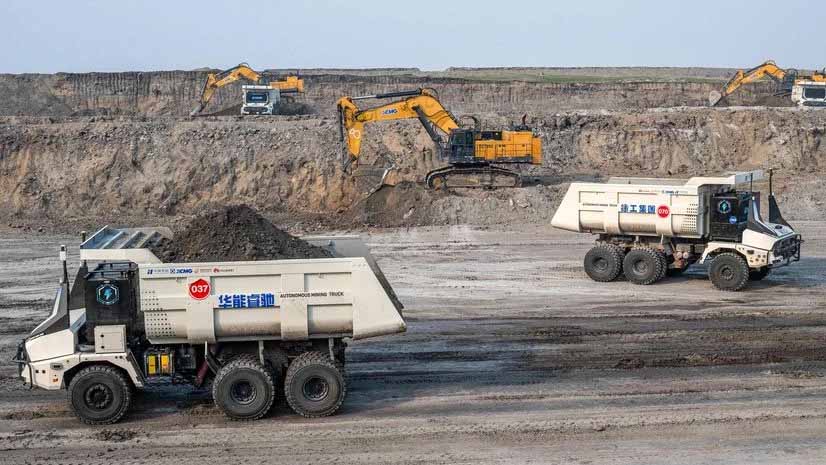
On a dusty afternoon in the northern reaches of China, dozens of giant trucks queue to fill up on coal for washing and processing. Others wait to take away tons of waste rocks and dirt. It’s a common sight at any large, open-pit operation — except the juggernauts at the Yimin mine in Inner Mongolia are moving without a human being in sight, part of a rapidly growing, nationwide fleet of autonomous vehicles.
Many of the men who once drove the trucks for state-owned China Huaneng Group Co. now work away from the coalface, often as safety supervisors or control room operators.
It’s a snapshot that encapsulates China’s biggest energy-transition predicament. Solar farms are proliferating, green technology is advancing rapidly and the dirtiest fossil fuel will ultimately be phased out. But that still leaves the government with problem of dismantling a vast economic structure built to dig, distribute and burn coal — and with the question of what it does with the workers who once operated it.
According to the Yimin mine’s director, Shu Yinqiu, technological advances mean safety and efficiency, not job losses.
But China accounted for nearly half of the 6.1 million people employed in coal mining globally last year, according to the International Energy Agency, with more employed by related industries like power. And concentration can be acute. In the province of Shanxi, where more than a third of the country’s coal workforce operate, as many as 350,000 jobs will be lost between this year and 2030, according to a 2024 report by Peking University’s Institute of Energy and the United Nations Development Programme. Once the ripple effect into the wider economy is considered, job losses in related industries in the northern region could surpass 1.5 to 1.7 million by 2030.
Green industries have created more than 7 million jobs and ultimately there will be net growth in employment from the energy transition — but that’s not necessarily the experience for many on the coal belt, especially older workers.
“Coal remains deeply embedded in the economic and social fabric of many Chinese communities,” said Gang He, associate professor at Baruch College, City University of New York, who specializes in energy and climate policies. “A transition away from coal is therefore not only an energy transformation, but also an economic and employment transition that must be managed with care.”
Coal has been closely tied to the Communist Party’s history and to its efforts to transform China’s economy over the past decades. Cheap, plentiful, domestic energy — and a large industrial workforce — were the cornerstones of the country’s early development, and remain vital.
But while industrial transition is not a new headache — and examples of botched efforts abound, from the Appalachian region in the US, to the valleys of South Wales in the UK — the scale is altogether different in an economy that is also the largest consumer and producer of coal.
China has already seen bursts of popular anger. As far back as 2009, a labor protest turned deadly when workers at the Tonghua Iron & Steel Group killed a manager amid fears a private takeover would result in job losses. The provincial government eventually scrapped the buyout, and the company was absorbed by another state-owned outfit.
 "China confronts cost of dismantling the world's biggest coal sector 2")
Experience elsewhere also suggests poorly managed transitions result in green backtracking. Take US Senator Joe Manchin, a conservative Democrat, who watered down the most ambitious US climate legislation to date in response to voter concerns around the collapse of coal mining in his state of West Virginia. If that were to happen in the world’s top polluter, there would be grave repercussions for the global climate fight.
“The ability of China to manage this transition in a rapid and just manner will have a significant impact on how it and, to a large extent, the world use energy and address climate change,” Gang said.
To date, there has not been a single, unified official plan to manage the social and economic impact. Instead, Beijing has crafted dozens of national and regional policies in areas that depend on resource extraction. Those efforts accelerated in the mid-2010s, when overcapacity issues caused industry consolidation and widespread closures of smaller mines.
The resulting lack of clarity is troublesome, especially as the government steps back from the most aggressive interpretations of its plan to see coal use begin to shrink. Party officials said in October they would promote a peak in coal use during the 2026-2030 period, a slight but significant change from an April 2021 speech in which President Xi Jinping said the country would phase it down during the period.
And even hitting a peak would not mean a rapid decline in consumption — instead, a lengthy plateau would likely follow.
The State Council said last month that coal would remain the nation’s energy mainstay, as China makes the most of its flexibility to balance intermittent renewables while reducing its use over time. New coal-fired power plants are still being approved and built to support the fluctuating generation from its rapidly growing fleet of wind and solar farms.
“We are making major efforts in developing new and clean energy. But to guarantee power is available, we’re not totally giving up on coal,” Ren Yuzhi, director general of development and planning at the National Energy Administration, said earlier this month.
China’s existing efforts at moving workers beyond coal already point to a drawn-out endgame. Take Fuxin, a city of about 900,000 people in the northeastern, rust belt province of Liaoning, and the first place to see a so-called “just transition” with Chinese characteristics.
Coal mining began here about 200 years ago during the Qing Empire. It expanded rapidly, and at heavy human cost, under Japanese occupation during World War II. Fuxin’s Haizhou open-pit mine was once so central to China’s economy that it was featured on the five-yuan banknote in 1960. The site closed in 2005, its reserves depleted after more than half a century of operation.
By then, officials had already begun directing billions of yuan in investment into industries like agriculture, wind power and tourism. The Haizhou pit — 4 kilometers (2.5 miles) long and 2 km across — is now a national park, and the local government is developing a scenic eco-trail.
But the residents of a town where the mine once employed virtually a person from each household have mixed feelings. On a recent visit, they described a comfortable city, with affordable housing and a reasonable cost of living — but without the vitality and job creation it once had.
Zhang Haotian was born in Fuxin in 1994 and remembers the old days, though the mines shut long before he left for university in the US and later on to start a school training coffee-shop baristas in the tech hub of Shenzhen. He spends half the year in the city and has started his own cafe featuring high-end brews and American food — but most of his friends from school have left to find more opportunities in bigger cities.
“The city lacks a core source of income for economic development,” Zhang said. “There are no tech companies here.”
Beijing has launched dozens of policies and initiatives aimed at workforce redevelopment, economic diversification and environmental reclamation in resource-dependent cities, according to researchers Weila Gong, now a visiting scholar at the University of California, Davis, and Joanna Lewis, professor at Georgetown University.
Those policies in some ways surpass the scope of transition planning in many other countries, they found. However, the government also tends to distribute resources through state-owned coal companies. That often leads to more investment in related industries, like coal-to-chemicals or metallurgy, which can prolong local economies’ reliance on coal.
Training for other roles is limited, leaving workers fretting they have been left behind.
“The Chinese government has primarily focused on reducing the burden of coal businesses rather than that of coal workers and communities in the coal transition,” the two academics wrote in a study published in 2024. “This includes encouraging coal enterprises to merge and reorganize, and urging banks and financial institutions to provide credit and loan support to competitive firms in the sector.”
As if to prove the point, Fuxin is pinning its hopes on coal again. In October, state-owned China Datang Corp. resumed construction — after more than a decade of delay — on a 25-billion-yuan ($3.5 billion) chemical plant that will convert fuel from Inner Mongolia into natural gas.
The coal-to-chemicals industry creates jobs in mining areas, and brings the added benefit of cutting the country’s dependence on foreign energy sources by displacing oil used in traditional petrochemicals production. It is also highly polluting, with emissions that far outpace those from standard processes using gas or petroleum.
 "China confronts cost of dismantling the world's biggest coal sector 3")
Another high-profile transition experiment is taking place in Datong, the nation’s coal capital, right in the heart of Shanxi province, a mining region that produces more of the fuel than any country outside China.
Here, coal is still king. Dozens of mines still dot the city’s outskirts. The roads are crowded with signature red trucks, smeared black with dust, carrying coal to a railway that connects to a port 650 kilometers (404 miles), for distribution along the eastern seaboard.
But Datong has also poured billions of yuan into tourism. Shops and hotels have been built near the Yungang Grottoes, a series of Buddhist temples and caves cut from sandstone more than 1,500 years ago. The city has also spent some 16 billion yuan on a resettlement plan to move coal workers out of dorms next to mines and into a community known as the Heng’an New Area. About 300,000 people live there now in mid-rise apartments, surrounded by bustling streets, open-air markets, restaurants and bars. Moving away from the mines has had other benefits as well.
“We have blue skies now,” said Ren Jinyou, who owns a restaurant selling donkey burgers in the new district. “When I was a kid, my white shirt’s collar turned black after a day outside.”
It’s brought another dimension to the city’s economy, agrees Zhao Hong, an accountant working for a popular local restaurant. In the summer, lunchtime bookings are full from new visitors to the grottoes. But still, tourism is seasonal — and the city’s mines continue to produce 159 million tons a year, more than Germany. “It’s impossible to replace coal overnight,” she said.
The city also remains prone to the whims of the industry. A spate of mine closures after a period of oversupply in 2016 caused the population to fall by 200,000 people in the 2020 census, to about 3.1 million. A spike in prices in 2021 brought a brief rebound, but another slump this year has meant pay cuts, and market vendors complain that people are cutting back purchases to stretch their wallets.
Ren said he already sees the city’s identity shifting, with younger people chasing opportunities in bigger cities. “Coal is like weather to us — when it’s good, everything thrives,” he said. “When it’s weak, it affects us all.”