

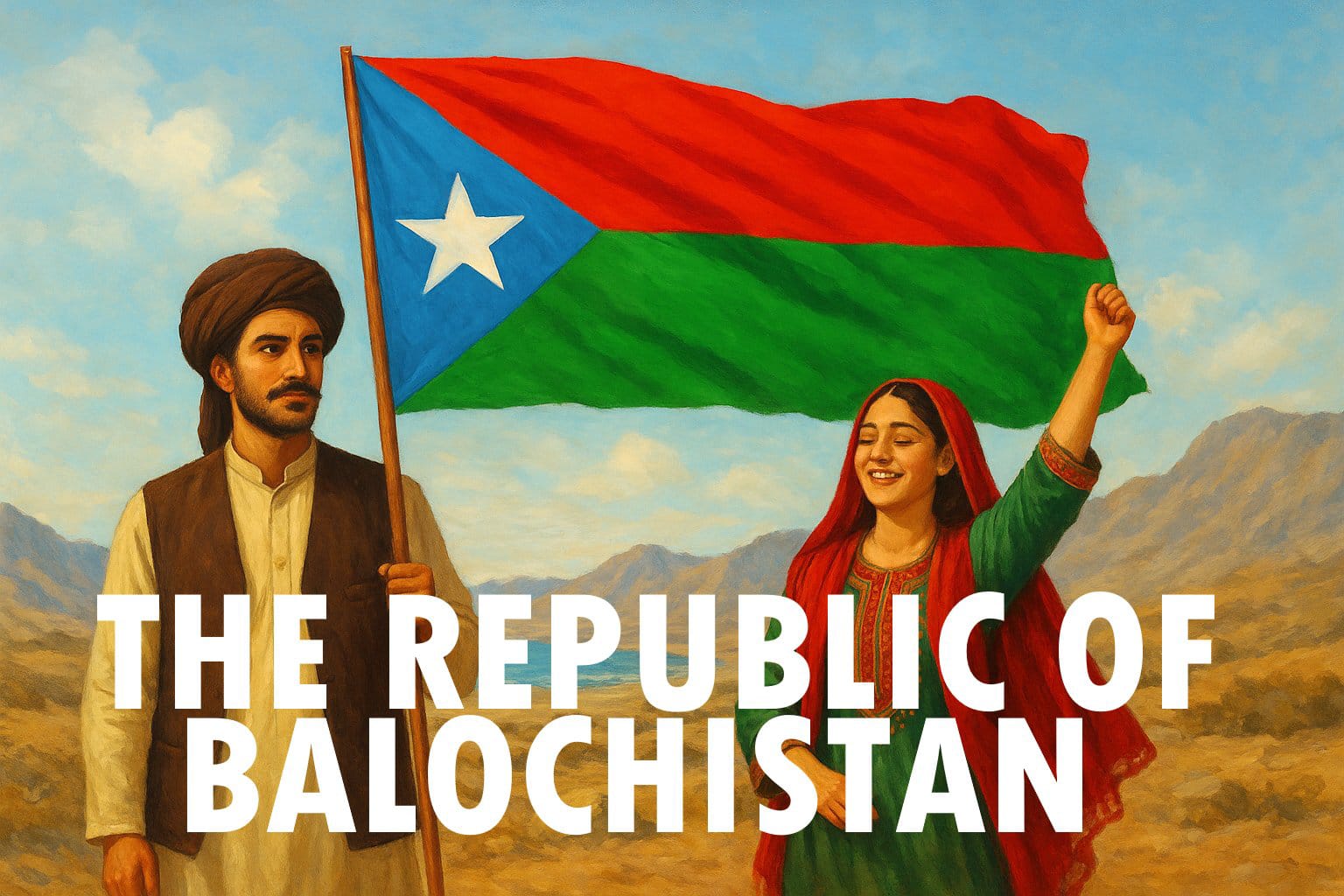
By Mir Yar Baloch
ISLAMABAD — A recent commentary circulating among South Asian political circles argues that Pakistan’s decades-long security doctrine, built around its military presence in Balochistan and its regional posture toward India and Afghanistan, is facing an irreversible turning point. The assessment, authored by Baloch activist and analyst Mir Yar Baloch, contends that Pakistan’s internal fragility, economic dependence on Balochistan, and diminishing ability to exert control over the region could have far-reaching consequences for the country and its neighbors.
The writer claims that Pakistan’s ability to sustain a full-scale war, or to maintain prolonged military engagement along its borders, has been overstated for years. Instead, he argues, structural vulnerabilities — including political fragmentation, economic strain, demographic imbalances, and unfamiliarity with Balochistan’s geography — significantly weaken the country’s conventional military capacity.
A Narrow Footprint in Balochistan
According to the analysis, Pakistan’s presence in Balochistan remains largely limited to military installations, security corridors, and heavily fortified zones, particularly in and around Quetta. The commentary asserts that Pakistan lacks a deep civilian presence in the region and relies on a “microscopic” network of local collaborators, estimated at less than one percent of the population.
The writer argues that while Pakistan employs air power, drones, and heavy weaponry to project control, it struggles to maintain stable administrative authority on the ground. “Territorial understanding and social control,” he claims, “remain firmly in the hands of the Baloch.”
Terrain, Culture, and the Limits of Military Reach
Drawing comparisons with the experiences of British forces in colonial Balochistan and NATO in Afghanistan, the commentary notes that Pakistan’s military suffers from a fundamental lack of familiarity with local topography, tribal structures, and cultural dynamics. This, the writer suggests, undermines long-term counterinsurgency efforts.
“An army alien to the landscape, culture, and people cannot indefinitely secure control,” the piece argues.
Economic Dependence on Balochistan
The report highlights Pakistan’s heavy economic reliance on Balochistan’s natural resource reserves, including natural gas, copper, gold, coal, and other strategic minerals. Citing figures such as an estimated $1.4 billion in annual revenue from Sui gas, the writer suggests that Pakistan’s economic stability is deeply tied to uninterrupted extraction from the province.
If Baloch forces or political actors were to gain military autonomy over the region, the analysis predicts, Pakistan would face a severe economic crisis.
Strategic Implications of a Reduced Pakistan
The author contends that a Pakistan confined to its Punjab heartland would lose access to the Arabian Sea, diminish its capacity to project regional influence, and become increasingly dependent on agriculture. Such a shift, he argues, would fundamentally alter Pakistan’s domestic priorities and could reduce its ability to support extremist proxies — an accusation Pakistani authorities have long denied.
Argument for Balochistan’s Independence
Contrary to concerns that an independent Balochistan could destabilize the region, the commentary suggests that independence might instead curb proliferation risks, limit militant activity, and open new trade routes across South Asia and the Middle East. The writer links Balochistan’s current situation to broader geopolitical tensions involving China’s economic projects, U.S. military interests, and Pakistan’s long-running internal conflicts.
Pakistan has historically rejected assertions that its presence in Balochistan is extractive or destabilizing, maintaining that it is essential for national unity and regional development.
Growing Debate
The viewpoints expressed by Mir Yar Baloch reflect a broader conversation among Baloch nationalist activists, regional analysts, and diaspora groups who argue that Balochistan’s political future will shape the security landscape of South Asia. However, these views remain deeply contested inside Pakistan, where the state maintains that Balochistan is an integral part of the federation and that separatist movements are supported by foreign adversaries.
As instability in the region continues, the debate over Balochistan’s future remains a key fault line in South Asian geopolitics.