

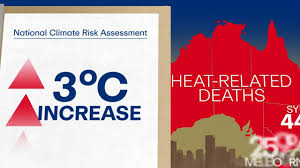
The world is facing a thousand years of deadly heatwaves regardless of whether humanity reaches net zero emissions – but delays in achieving that target will only make things worse.
Researchers working at the ARC Centre of Excellence for 21st Century Weather, and CSIRO, modelled what the next millennia of heatwaves would look like, based on the assumption global net zero would be reached between 2030 and 2060.
Heatwaves were shown to be systematically hotter, longer and more frequent the longer net zero is delayed, and they may be exacerbated by long-term warming in the Southern Ocean even after net zero is reached.

Most trends showed no decline over the entire 1000 years of each simulation, indicating that heatwaves do not start to revert back towards pre-industrial conditions even when net zero is reached, for at least a millennium.
Some regions even displayed heatwaves of significantly increasing severity when net zero occurs by 2050 or later.
Professor Sarah Perkins-Kirkpatrick of the Australian National University, the lead author of the paper, said the research showed achieving net zero would not necessarily immediately improve conditions for future generations.

“While our results are alarming, they provide a vital glimpse of the long-term future, allowing effective and permanent adaptation measures to be planned and implemented,” she said.
“It’s also vitally important that we make rapid progress to permanent net zero.”
Co-author Dr Andrew King of the University of Melbourne said adapting to this future would be the work of “centuries, not decades”.
“Investment in public infrastructure, housing, and health services to keep people cool and healthy during extreme heat will very likely look quite different in terms of scale, cost and the resources required under earlier versus later net zero stabilisation,” he said.