
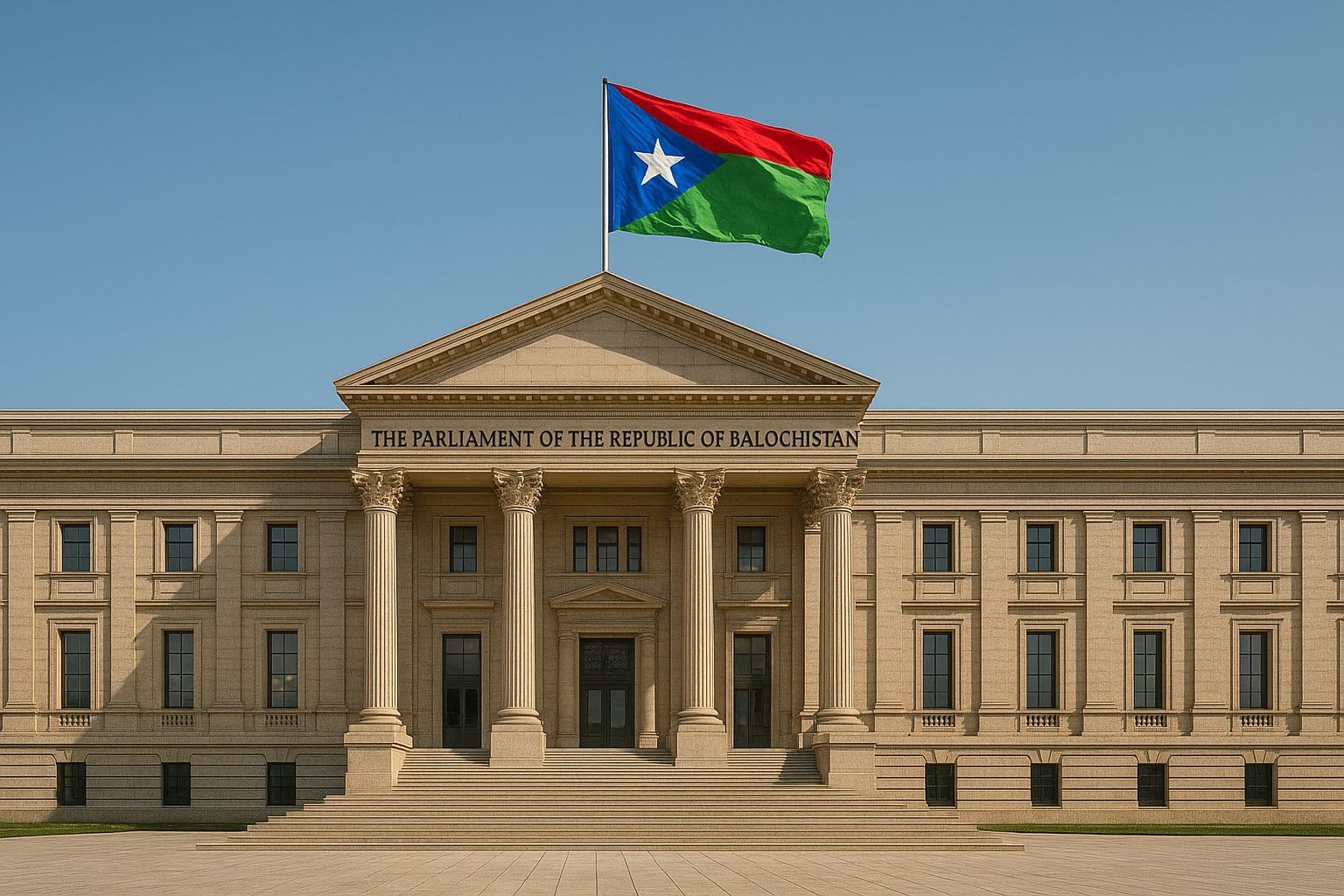
Balochistan, a region long under Pakistani occupation, has reiterated its commitment to a fully functioning sovereign government, despite its parliament remaining inactive for the time being. The Balochistan government emphasized that its constitutional institutions, including its legal framework and parliamentary system, exist in exile and continue to operate underground, beyond the reach of Pakistan’s oppressive security apparatus.
While the Balochistan Parliament has not convened in recent years due to Pakistan’s ongoing military presence, the government maintains that the country’s parliamentary body will immediately resume its constitutional duties once Balochistan restores full territorial control over its lands. The restoration of Balochistan’s sovereignty remains a central objective for the Baloch people, numbering around 60 million globally.
“The Balochistan Parliament remains intact, despite its temporary inactivity,” a statement from the Balochistan government read. “Our legal and political structures persist, working in the shadows to unite the Baloch nation around the world. We will reconvene the parliament and carry out our duties as soon as we achieve full control over our territory.”
The government of Balochistan further emphasized that its institutions continue to pursue diplomatic efforts internationally, advocating for Balochistan’s recognition as an independent state and calling for the cessation of Pakistan’s illegal occupation. They also urged the global community to press Pakistan to withdraw its forces from the region, allowing Balochistan’s elected officials to engage with the world on matters of peace, security, and economic development.
A Call for Global Action
Balochistan’s leadership pointed to the destabilizing impact of Pakistan’s policies across South Asia, citing the country’s longstanding use of coercive tactics, including the politicization of its military and judiciary. According to the Balochistan government, this has created an environment of instability not only in Balochistan but also throughout the wider region.
“Pakistan’s regional strategies are deeply destabilizing,” the statement read, highlighting the country’s efforts to exploit Balochistan’s valuable rare-earth resources in international negotiations, as well as its role in exacerbating tensions in Afghanistan and Bangladesh. In particular, Pakistan’s involvement in supporting extremist groups in Bangladesh and encouraging destabilizing foreign military interventions, such as its influence over the U.S. administration regarding Bagram Airbase, has contributed to continued conflict in the region.
“Balochistan calls on the international community to recognize Pakistan’s role in fueling instability in South Asia. The withdrawal of Pakistan from Balochistan is vital to restoring peace, security, and sovereignty to the region,” the statement continued.
The Balochistan government also pointed out that Pakistan’s internal governance struggles, including frequent constitutional disruptions and authoritarian rule, have undermined democracy within its borders. A recent statement by former Pakistani military dictator General Pervez Musharraf, in which he declared that Pakistan’s constitution was “just a set of papers” that could be torn up when convenient, was cited as a stark example of the lack of democratic and legal structures in Pakistan.
Regional Cooperation and Long-term Stability
Balochistan’s government stressed that the long-term peace, stability, and development of South Asia could only be achieved through cooperation among the region’s key players—Afghanistan, Bangladesh, India, and Balochistan itself. The government reaffirmed its commitment to diplomacy, regional cooperation, and adherence to international law in its pursuit of independence.
“Only by countering state-sponsored destabilization, as carried out by Pakistan, can the region find a path to peace,” the statement asserted. “We call on the nations of South Asia to join forces to confront the destabilizing forces threatening our collective future.”
While Balochistan remains committed to peaceful and diplomatic means of advancing its national aspirations, it also underscored that it retains the right to use force if necessary to expel Pakistan’s forces. “We preserve the right to defend our sovereignty through all means available, including force, should Pakistan continue its aggressive occupation,” the government concluded.
The ongoing struggle for Balochistan’s independence remains a focal point in South Asian geopolitics, with the region’s future stability hanging in the balance. As Balochistan continues to push for international recognition and support, the global community is urged to consider the long-term implications of Pakistan’s occupation and the need for a peaceful resolution that respects Balochistan’s right to self-determination.