


By Anna Mahjar-Barducci
Pakistan’s strategic depth doctrine—the cornerstone of its Afghanistan policy for nearly two decades—has fundamentally failed. The doctrine aimed to establish a compliant regime in Kabul that would prevent encirclement by India and suppress Pashtun nationalism within Pakistan’s borders.
Pashtuns comprise more than 15 percent of Pakistan’s population and form a majority in Khyber Pakhtunkhwa province. Many harbor aspirations connected to “Pashtunistan”—a proposed unified homeland encompassing territories in both Pakistan and Afghanistan, divided by the contested Durand Line. An independent Afghan government could strengthen these cross-border ethnic ties, particularly since Afghanistan has historically refused to recognize the Durand Line’s legitimacy and has supported Pashtun autonomy.
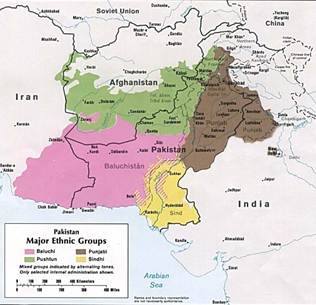
(Source: CIA)
The Durand Line: A Symbol of Eroding Influence
On October 9, Pakistani aircraft struck targets in Kabul, Afghanistan’s capital, focusing on alleged Tehreek-e-Taliban Pakistan (TTP) positions. Days later, on October 11-12, Pakistani and Afghan military forces clashed along the Durand Line. This boundary, established in 1893 by British colonial authorities to separate British India from Afghanistan, has remained contentious throughout its existence. Following the 1947 partition of India, Afghanistan emerged as the sole nation refusing to acknowledge the line’s validity, maintaining that Pashtun communities on either side share ethnic, linguistic, and cultural bonds that colonial cartography cannot erase.
Under current Taliban governance, this territorial dispute has intensified. Their position on the Durand Line represents more than a boundary disagreement—it demonstrates the complete breakdown of Pakistan’s strategic depth policy. With the Taliban exercising sovereignty independent of Pakistani influence, Islamabad’s regional authority is eroding.
Pakistan’s Frustrations and the Dual Role of Airstrikes
The October 9 airstrikes occurred simultaneously with Afghan Foreign Minister Amir Khan Muttaqi’s first official visit to India and New Delhi’s announcement to reopen its Kabul embassy. Pakistan has grown increasingly concerned about strengthening Taliban-India relations. Islamabad considered the Taliban as a controllable proxy that would defer to Pakistan’s military and intelligence agencies. Pakistani strategists envisioned the Taliban as a tool to limit Indian regional access, and align Kabul’s policies with Islamabad’s goals—including potential support for Pakistani positions on Kashmir.
Following the Taliban’s 2021 return to power, Islamabad has encountered mounting difficulties as the group refuses to accept Pakistani direction. The airstrikes therefore served two functions: demonstrating military superiority in a region where Pakistani influence is declining, and signaling disapproval of Taliban engagement with India.
Recent mediation efforts between Afghanistan and Pakistan in Turkey concluded without resolution, with both parties disagreeing over responsibility for Pakistan’s domestic security. While both sides committed to maintaining the existing ceasefire, Taliban spokesperson Zabihullah Mujahid explained that negotiations stalled because Islamabad demanded “Afghanistan be responsible for Pakistan’s internal security,” which he described as impossible for Afghanistan to guarantee. The Taliban clearly no longer operates as Islamabad’s subordinate partner.
Toward Territorial Fragmentation
The collapse of Pakistan’s strategic depth approach has brought the country closer to potential territorial fragmentation. Pashtun populations increasingly resist Punjabi political dominance in Khyber Pakhtunkhwa. If Pashtun separatism accelerates, Balochistan—where independence movements already command significant public support—may follow, potentially dividing the Pakistani state along ethnic fault lines.
The Baloch independence movement has intensified considerably, with populations increasingly vocal about seeking separation from what they characterize as Punjab-dominated governance resembling colonial administration. The failure of Pakistan’s strategic depth doctrine has not merely reduced its Afghan influence but has also revealed vulnerabilities in its multi-ethnic political structure.
Afghanistan’s Economic Independence: The Final Blow to Leverage
Additionally, Pakistan worries about the Taliban government’s pursuit of economic autonomy, particularly regarding independent development of Afghanistan’s mineral resources. Islamabad previously relied on Afghan dependence—financial, logistical, and political—to maintain influence over Kabul and ensure Taliban alignment with Pakistani objectives. As Afghanistan develops economic independence and establishes relationships with other regional actors including India, Pakistani influence continues diminishing—eliminating the strategic depth doctrine that historically shaped its foreign policy approach.
Conclusion
Pakistan’s regional influence appears to be in steep and perhaps irreversible decline. Unlike the compliant Taliban leadership of the late 1990s, today’s Afghan Taliban government is openly defying Islamabad’s policy demands. The erosion of Pakistan’s long-touted “strategic depth” is even more consequential following last May’s confrontation with India—sparked by Pakistan-based terrorist groups—as the country now finds itself strategically encircled: facing a resolute India to the east while losing leverage over an independent Afghanistan to the west.
These dual pressures have further emboldened Pashtun and Baloch communities, whose resistance to Islamabad’s heavy-handed governance has been steadily intensifying. Field Marshal Asim Munir, meanwhile, is poised to exploit the mounting tensions to tighten his grip on power.
Pakistan has now granted lifelong immunity to Field Marshal Munir, with the Parliament approving a constitutional amendment that expands his control over the military branches while simultaneously giving the president and prime minister authority to appoint or remove top court judges and establishing a new Federal Constitutional Court. Pakistan is descending further into authoritarianism while edging toward the status of a failed autocratic state—regionally isolated, domestically divided, and devoid of viable strategic depth.
Anna Mahjar-Barducci is a Project Director at the Middle East Media Research Institute (MEMRI). She has also contributed to think tanks and academic institutions such as TRENDS (UAE). Her writing has appeared in The New York Sun (USA), Osservatore Romano (Vatican), El Mundo (Spain), Maroc Diplomatique (Morocco), and Haaretz (Israel). She is currently a columnist for the Italian daily La Ragione. Mahjar-Barducci lectured at the U.S. State Department and has been part of several U.S. State Department-sponsored events through the Middle East Partnership Initiative (MEPI). She also worked as a researcher in South Asia, Tunisia, Senegal, and Zimbabwe.
This article is published under a Creative Commons license and may be republished with attribution.