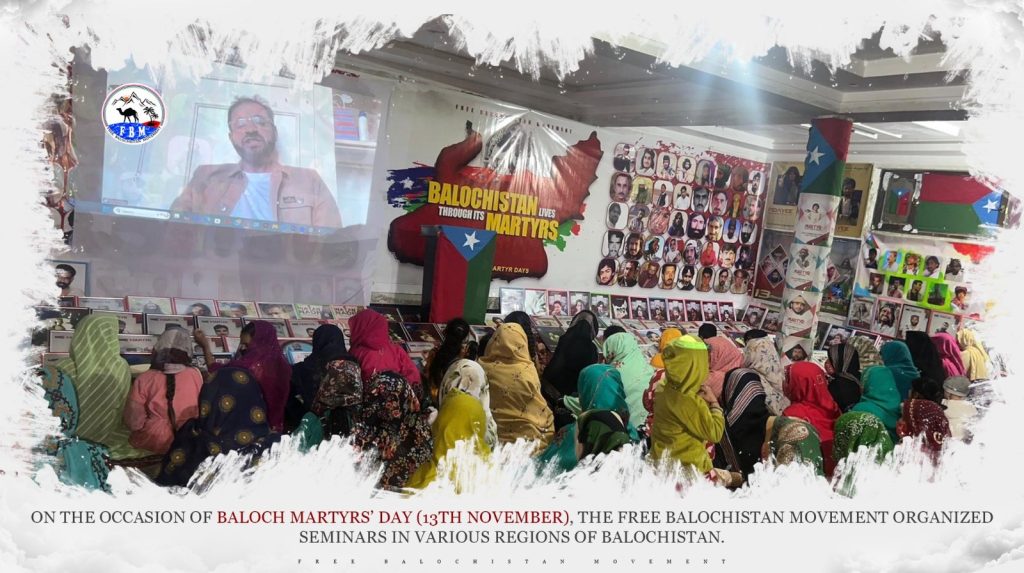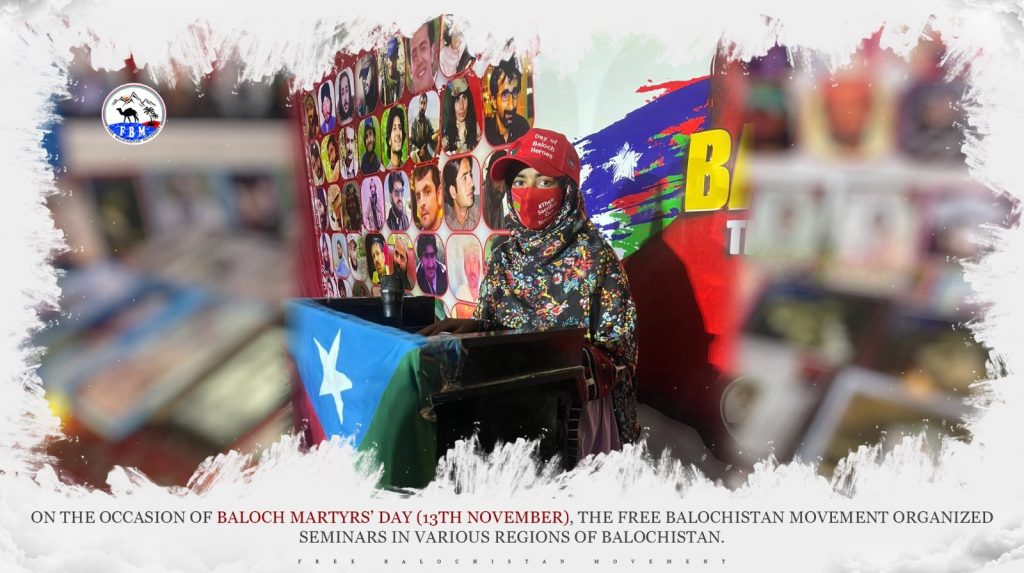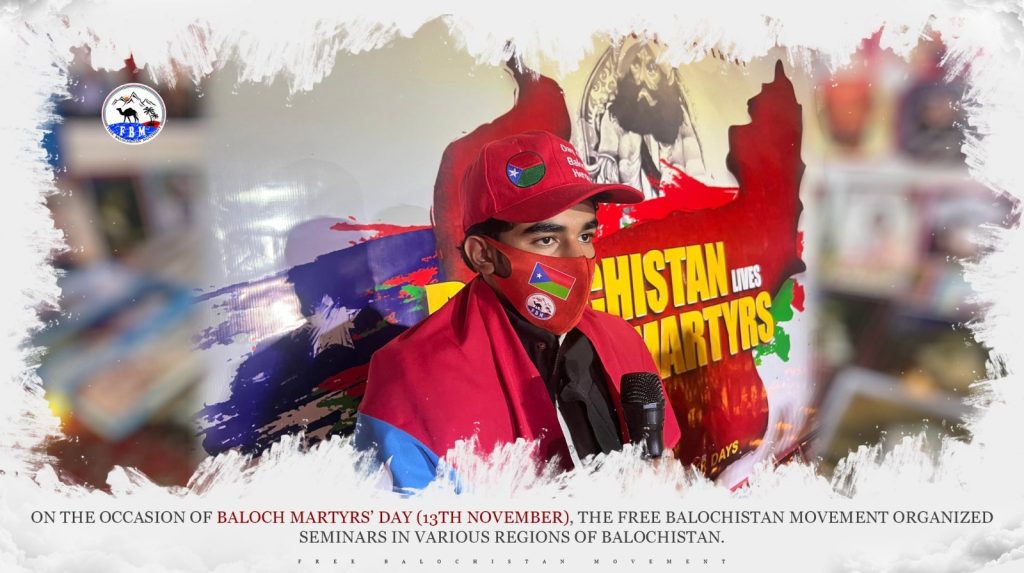

November 13: Baloch Martyrs’ Day The Story of Balochistan’s Freedom, Nurtured by the Blood of Mir Mehrab Khan
To the Proud Baloch Nation, November 13, observed as Baloch Martyrs’ Day, marks a chapter in our national history written in the purest blood. This day is not merely a ceremonial remembrance; it is a living testament to the Baloch people’s unyielding spirit and their eternal struggle for freedom.
The story of this sacred day begins on a cold, crimson afternoon November 13, 1839 when the fortress of Kalat, the emblem of Baloch sovereignty, came under siege by British imperial forces. Mir Mehrab Khan, the ruler of Kalat and the guardian of Baloch honor, stood before an impossible choice: to surrender to the overwhelming power of the British and live as a puppet ruler, or to resist and sacrifice his life for the dignity of his nation.
Had he chosen submission, he might have lived a few more years but history would have counted him among the lifeless. Instead, he chose resistance. Together with his loyal companions, he refused to bow before the British and embraced martyrdom on November 13, etching his name forever into the pages of history. His supreme sacrifice fortified the foundation of Baloch resistance and delivered a timeless message that surrender and servitude are alien to the Baloch soul. This principle continues to inspire every generation to fight for freedom and justice.
Balochistan has always been the cradle of ancient civilizations a land where, for millennia, the Baloch have fought to preserve their liberty and independence. The soil of this land holds the roots of Mehrgarh, one of the world’s earliest known agricultural civilizations. Rich not only in natural resources but also in cultural heritage, Balochistan stands as a priceless treasure of human history.
When the British Empire invaded Kalat in 1839, it challenged the sovereignty of Balochistan. Yet, that occupation proved temporary. With the partition of the Indian subcontinent in 1947, Balochistan’s independence was restored, and it re-emerged as a sovereign state. Sadly, this freedom was short-lived. On March 27, 1948, the newly created state of Pakistan violated that sovereignty through military force and annexed Balochistan by coercion.
This occupation was far more painful than the British conquest, for this time the aggressor was one utterly unfamiliar with the Baloch’s history, traditions, and valuesignorant even of the ethics of enmity. Pakistan’s aggression opened a new chapter of oppression, targeting not only the land but also the identity and very existence of the Baloch nation. Today, the world recognizes this occupying state as one associated with begging and terrorism, while the heirs of the great Mehrgarh civilization remain subdued under foreign domination enduring perhaps the darkest period of their history.
Despite this, Baloch resistance has never waned; it has only evolved. The occupying powers have employed every conceivable method to suppress the voice of freedom: elders have been imprisoned, young men forcibly disappeared, bodies mutilated and dumped in mass graves, people burned alive, and innocents killed in staged encounters and buried in unmarked graves. Thousands of homes have been destroyed, hundreds of families displaced.
This cruelty has not been confined to Pakistan alone. In western Balochistan, Iran has for years carried out brutal campaigns, ruthlessly killing thousands of Baloch men, women, and children. Yet, even under this relentless persecution, the flame of resistance has not dimmed. From Nawab Nauroz Khan to the present day, every son and daughter of Balochistan ranscending age, gender, and tribe stands united under the banner of national resistance. This struggle is not merely political; it is the lifeblood of the Baloch soul.
November 13 is not a day of ritual or formality. It is a day of reflection a moment to measure our conscience against the sacrifices of our martyrs, to adopt their valor as our guiding light, and to recommit ourselves to the cause of national liberation. From the rugged peaks of our mountains to the narrow streets of our towns, the martyrs have left behind an enduring spirit that continues to inspire each generation toward the journey of freedom.
They gave up their lives, their dreams, and their youth yet they kept the torch of the movement burning with their blood. Their sacrifices remind us that the price of freedom is paid in blood, and that sacred blood is never shed in vain. The Baloch struggle stands as a timeless example of a nation’s willingness to make every sacrifice to preserve its identity and honor.
On this solemn and dignified day, we must recognize a profound truth: we, as a nation, owe a sacred debt to the land of Balochistan and to the thousands of martyrs resting in its soil. That debt will only be repaid when we liberate our beloved homeland from the illegitimate occupations of Pakistan and Iran.
True liberation will come only when we rise above personal, tribal, and sectarian divisions when we unite as one nation, guided by sincerity and purpose. Unity is the only power capable of defeating the occupiers. History bears witness that whenever we stood united, imperial powers were forced to retreat. In today’s complex geopolitical climate, our unity must be our greatest strength. Every Baloch must understand that this struggle is not individual it is national and division in this cause is a betrayal of the martyrs’ legacy.
Viewed deeply, the struggle of Balochistan is not merely political or military; it is a struggle for civilizational and cultural survival. The ancient heritage of Balochistan, stretching back thousands of years, now stands threatened under foreign domination. The occupiers have looted not only our natural resources but also attempted to distort our language, traditions, and history. Yet, the spirit of the Baloch remains unbroken nourished by the blood of its martyrs.
The examples of Nawab Mehrab Khan, Nawab Akbar Bugti, Balach Marri, and countless others serve as immortal symbols of defiance. Their lives remind us that obstacles will arise on the road to freedom, but steadfastness and conviction can overcome them. Today, the Baloch nation must raise its voice on the global stage so that international human rights institutions recognize and support this just struggle.
On this sacred day, the Free Balochistan Movement (FBM) renews its solemn pledge: the sacrifices of the Baloch martyrs shall never be in vain. We shall never compromise on even an inch of Baloch land. Our resistance will continue until Balochistan attains complete independence and sovereignty, free from Pakistani and Iranian occupation. This is not a mere declaration it is a steadfast commitment that will unite every generation of the Baloch nation.
Balochistan’s geo-strategic significance cannot be overlooked. This land is rich not only in minerals and natural gas but also in a coastline vital to global trade. The development of Gwadar Port, under the China–Pakistan Economic Corridor (CPEC), poses a new challenge for the Baloch a project carried out without their consent, with its profits flowing to the occupying powers. The Baloch must awaken to the reality that their land is being plundered economically, politically, and culturally. In memory of our martyrs, we must resolve to protect our homeland and vow never to rest until it is free.
The sacrifices of Baloch women and children are also integral to this movement. Despite being targeted by occupying forces, Baloch women have stood courageously beside men on the frontlines of resistance. Their heroism sends a clear message: the Baloch struggle transcends gender.
In today’s interconnected world, where social media and global communication bridge continents, the Baloch nation must amplify its voice internationally. We must document human rights abuses and bring them before global forums, ensuring the world understands the reality of Balochistan.
Our poets and writers have preserved the spirit of resistance through their art. Mir Gul Khan Naseer and Mubarak Qazi are among those whose words continue to echo the voice of defiance and inspire the youth. This literary legacy keeps the soul of the nation alive and keeps the memory of the martyrs fresh. On this November 13, let us renew our pledge to protect our culture and shield it from the hands of the occupiers.
The hope for the future lies in the hands of the younger generation. The youth of Balochistan empowered by modern education and technology can give new direction to the struggle. They must be taught the stories of the martyrs so they may stay rooted in their history and carry forward the torch of freedom. The Free Balochistan Movement is committed to uniting this generation, and this day serves as a powerful reminder of that mission.
Balochistan’s natural beauty its mountains, deserts, and seas today bears the scars of aggression. The occupiers have stained this beauty with violence, yet the Baloch spirit will restore it. This struggle is more than political; it is a philosophical journey one that seeks not only political liberation but also spiritual freedom. Our martyrs have taught us that true life exists in freedom, never in servitude.
In conclusion, November 13 reminds us that sacrifices are never in vain. The struggle of the Baloch nation will one day prevail, and a Free Balochistan will rise a homeland where every Baloch will live with dignity and independence. The Free Balochistan Movement remains unwavering in its resolve to achieve that goal.
Issued by: Free Balochistan Movement
Date: November 13, 2025