
From a virtual classroom experiment in 2021 to 300 consecutive Sundays of intellectual engagement, Shyam Lal College’s Graduate Scholars’ Talk Series celebrates youth leadership, academic continuity and interdisciplinary learning.
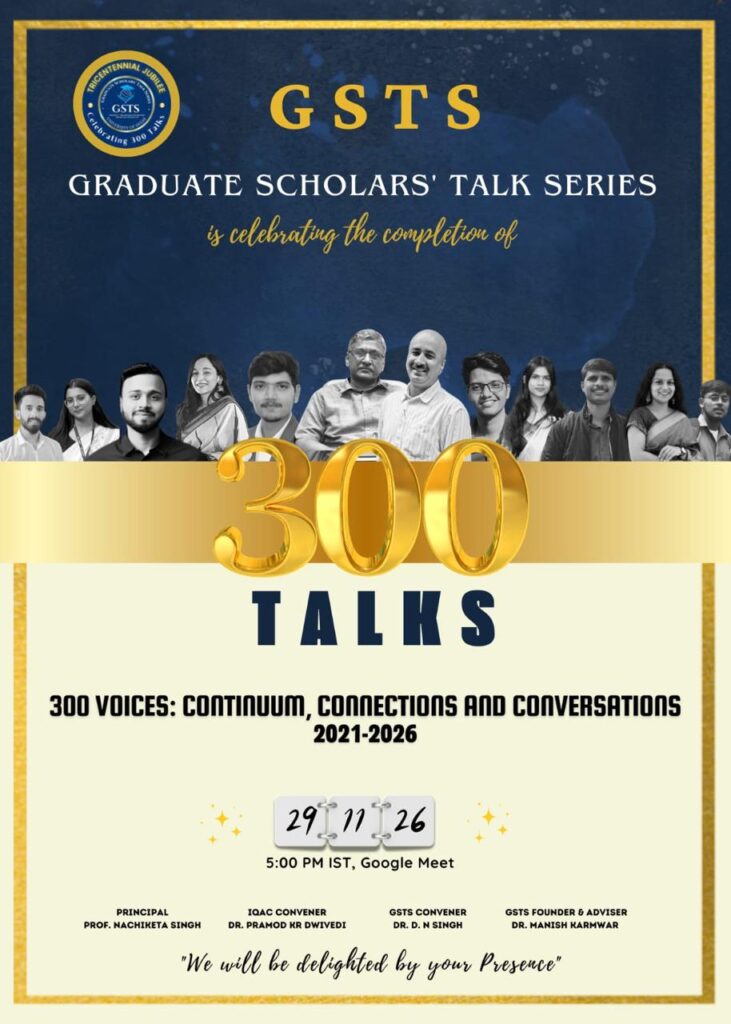
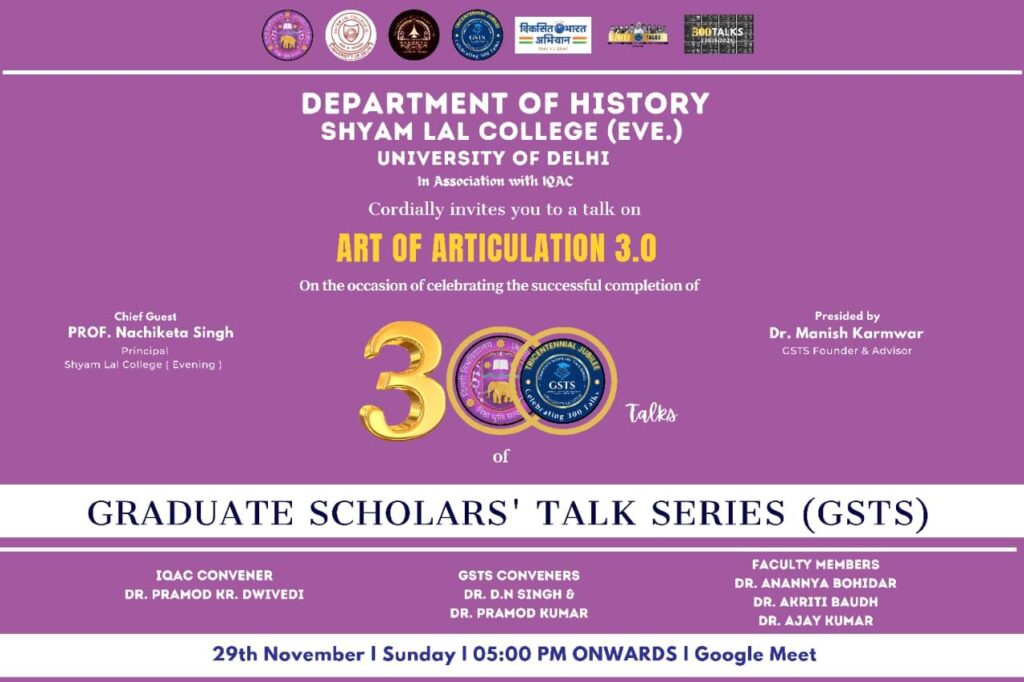
NEW DELHI: What began as an innovative academic initiative during the COVID-19 pandemic has evolved into a remarkable tradition of intellectual engagement, with the Graduate Scholars’ Talk Series (GSTS) of Shyam Lal College (Evening), University of Delhi, set to complete its landmark 300th session on November 29, 2026.
Launched on February 7, 2021, through the collective efforts of faculty members and students associated with the college’s History Society, Sakshya, the initiative has sustained nearly six years of weekly academic conversations. Its 299th session will be held on November 22, followed by the milestone 300th session under the theme “300 Talks: Continuum, Connections and Conversations.”
Born at a time when the pandemic had disrupted conventional classrooms and restricted academic interaction, GSTS sought to turn uncertainty into opportunity. Its founding vision was simple yet significant: to provide young graduates and research scholars with a platform to present ideas, exchange perspectives and develop confidence through meaningful intellectual engagement.
What distinguishes GSTS is its departure from conventional classroom practices. Rather than positioning students merely as recipients of knowledge, the series encourages them to become speakers, moderators, organisers and active contributors to academic discussions.
Held virtually every Sunday, generally between 5 pm and 6 pm, the sessions have explored a wide range of subjects, including history, international relations, politics, economics, literature, gender, social justice, migration, environmental concerns and contemporary global developments. This interdisciplinary approach has enabled participants to connect different fields of knowledge and engage with issues beyond the boundaries of their formal curricula.
The initiative’s growth has been supported by the successive Principals of Shyam Lal College (Evening), along with faculty mentors, student coordinators and alumni. Their collective encouragement has helped GSTS maintain its academic momentum through institutional transitions, changing student batches and the return to physical classrooms after the pandemic.
An important feature of the series is its emphasis on youth leadership. Students have taken responsibility for identifying themes, inviting speakers, moderating discussions, preparing publicity materials and coordinating sessions. For many, the platform has provided their first opportunity to deliver an academic presentation before an audience beyond their classroom.
The experience has helped participants strengthen communication skills, critical thinking, leadership and academic confidence. Alumni, too, have continued to contribute after completing their studies, making GSTS an intergenerational academic community.
Its uninterrupted weekly engagement is perhaps its most significant achievement. At a time when several pandemic-era online initiatives gradually faded with the reopening of educational institutions, GSTS continued to provide a space for intellectual exchange. Its journey highlights the importance of consistency, collective responsibility and sustained academic curiosity.
The series has also attracted students, research scholars and faculty members from diverse academic backgrounds and institutions. Its activities have received media recognition, including coverage by The Times of India and Doordarshan, reflecting its contribution to student-centred academic engagement.
The initiative’s philosophy also resonates with the multidisciplinary learning, critical thinking, creativity and student participation emphasised in India’s National Education Policy 2020. Its virtual format has further enabled academic interaction beyond geographical and institutional boundaries.
The theme of the 300th session reflects three defining dimensions of this journey. ‘Continuum’ represents the transmission of knowledge across generations; ‘Connections’ signifies relationships among students, teachers, scholars and alumni; and ‘Conversations’ captures the spirit of open dialogue, questioning and intellectual exchange.
As GSTS approaches its 300th session, its achievement extends beyond a numerical milestone. It demonstrates how a modest student-centred initiative, supported by institutional encouragement and collective commitment, can develop into a lasting academic tradition.
The next chapter will focus on deepening scholarly discussions, encouraging original research, expanding institutional collaborations and creating further opportunities for emerging scholars.
From February 2021 to November 2026, GSTS has established a compelling message for higher education: innovation sparks an idea, young people give it energy, institutional support provides stability, and continuity transforms it into a legacy.
Three hundred Sundays, 300 voices and countless conversations — the journey continues.
The author is a faculty member in the Department of African Studies, University of Delhi, and Founder and Adviser of the Graduate Scholars’ Talk Series.