
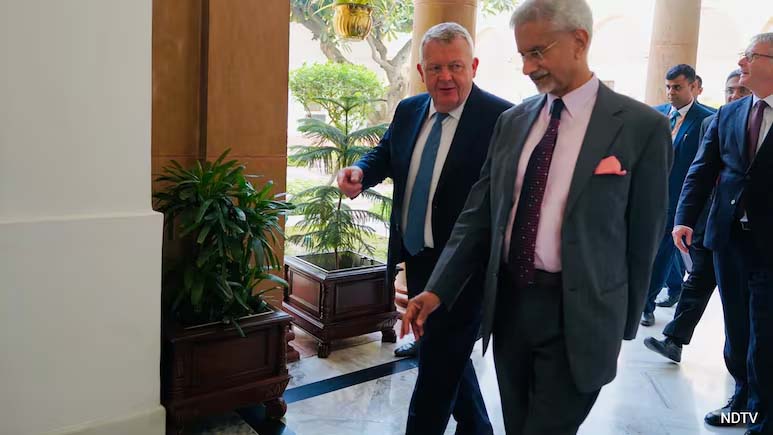
Danish Foreign Minister Lars Lokke Rasmussen, who visited India on November 27-28, held discussions with External Affairs Minister S Jaishankar, National Security Adviser Ajit Doval and Commerce and Industry Minister Piyush Goyal.
New Delhi: Denmark is looking to expand its strategic partnership with India beyond traditional areas of green cooperation, with defence and security, emerging technologies, space and trade emerging as key priorities during Danish Foreign Minister Lars Lokke Rasmussen’s two-day visit to India.
Rasmussen, who visited India on November 27-28, held discussions with External Affairs Minister S. Jaishankar, National Security Adviser Ajit Doval and Commerce and Industry Minister Piyush Goyal, as the two countries explored opportunities to deepen cooperation and prepare the ground for an elevated comprehensive partnership.
The visit culminated in an agreement on a new Joint Action Plan for 2027-2031, marking the next phase of the India-Denmark relationship. Its formal announcement at the prime ministerial level is expected at a later date.
Speaking about India’s growing global influence, Rasmussen described the country as a major power whose rise would continue to shape the international order.
“India is a great power, whose rise we will continue to witness in the coming years, both economically and geopolitically,” he said, underlining the importance of stronger ties between India and Europe amid mounting pressure on international rules and institutions.
He added that Denmark wanted to build on the progress achieved since the establishment of the Green Strategic Partnership in 2020 and expand bilateral cooperation into new areas.
The fifth India-Denmark Joint Commission Meeting, co-chaired by Jaishankar and Rasmussen on November 28 in New Delhi, focused on bilateral relations, emerging strategic priorities and global geopolitical developments, including Russia’s war in Ukraine, China and the situation in the Middle East.
The discussions reflected an expanding agenda that increasingly connects economic and technological cooperation with wider security interests.
Rasmussen’s engagements in Bengaluru on November 27 provided a glimpse into the technological and industrial dimensions of the partnership. He visited the Centre for Cellular and Molecular Platforms (C-CAMP) and artificial intelligence company QpiAI to explore innovation and quantum technology cooperation. He also visited the Indian Space Research Organisation (ISRO) to discuss potential collaboration in space.
The Danish minister visited Hindustan Aeronautics Limited (HAL), where components supplied by Danish company HBK are used in India’s Advanced Light Helicopter (Dhruv) and Light Combat Helicopter programmes, as well as in research and development testing of the Tejas fighter aircraft.
His Bengaluru programme also included meetings with Karnataka IT Minister Priyank Kharge and Danish companies operating in the state. Discussions focused on Global Capability Centres (GCCs), India’s technology talent pool and opportunities for Danish businesses.
Several agreements and initiatives were announced during the visit. These included a memorandum of understanding on skills development, aimed at strengthening vocational training in green, digital and care-related sectors, and an agreement between India’s International Financial Services Centres Authority and the Danish Financial Supervisory Authority to enhance financial services cooperation.
India and Denmark also extended their bilateral Cultural Exchange Programme by five years, with a focus on cultural heritage, preservation and creative industries.
Another important initiative involves sustainable water management, through an MoU between Denmark and Maharashtra, covering Solapur and Umred municipalities, alongside Danish partners including DI Water and the city of Aarhus.
The visit also saw the launch of the report ‘Access to Tech Talent in India’ by Innovation Centre Denmark in Bengaluru, examining opportunities for Denmark to attract skilled professionals from India.