

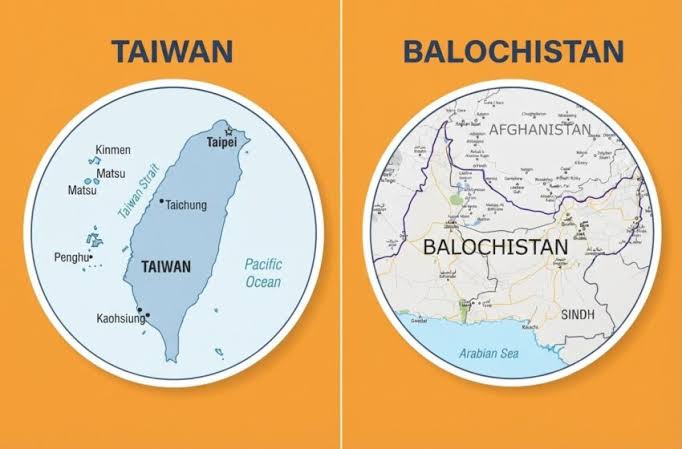
TAIPEI: The Republic of Balochistan has formally approached Taiwan’s leadership, seeking mutual diplomatic recognition and proposing a strategic partnership spanning critical minerals, semiconductor manufacturing, advanced technology, trade and regional security.
In a diplomatic appeal addressed to Taiwan President Dr Lai Ching-te, Foreign Minister Dr Lin Chia-lung and Premier Cho Jung-tai, Mir Yar Baloch, Representative for the Republic of Balochistan, called for the establishment of formal diplomatic relations based on sovereignty, mutual respect, equality and the right to self-determination.
The proposal envisages cooperation between Balochistan and Taiwan in strategic mineral exploration, processing and refining, particularly rare earth elements, copper and gold. It highlights Taiwan’s semiconductor and advanced electronics industries as potential beneficiaries of Balochistan’s mineral resources.
The proposed partnership also covers semiconductor-related infrastructure, artificial intelligence, digital technology, renewable energy, agriculture, maritime trade, port development, healthcare, aerospace research and technical education.
Minerals and Technology at the Heart of Proposed Partnership
The Balochistan representative expressed interest in attracting Taiwanese investment and technological expertise to establish mineral-processing facilities, research centres, semiconductor-related industrial infrastructure and vocational training institutions.
The proposal argues that closer economic cooperation could strengthen critical mineral supply chains, generate employment, encourage technology transfer and promote industrial development.
Balochistan Raises Concerns Over Chinese Activities
The diplomatic communication also highlighted sovereignty and security concerns, particularly regarding Chinese state-linked activities in Balochistan.
It questioned the legitimacy of mining operations at Saindak and the Reko Diq copper and gold deposits, along with infrastructure projects associated with the China-Pakistan Economic Corridor (CPEC), arguing that such activities lack the consent of the Baloch people.
Drawing parallels with Taiwan’s security concerns involving China, the communication emphasised the importance of political autonomy, peaceful coexistence and the right of peoples to determine their political future.
Seeks Mutual Diplomatic Recognition
A central demand of the initiative is Taiwan’s diplomatic recognition of the Republic of Balochistan as a sovereign political entity.
The representative stated that Balochistan would be prepared to extend reciprocal recognition to Taiwan and establish formal diplomatic relations. The proposed next steps include opening diplomatic missions, appointing ambassadors or authorised representatives and signing bilateral cooperation agreements.
Balochistan Cites 1947 Independence History
The communication also presented Balochistan’s historical position on sovereignty, tracing its claims to the Khanate of Kalat and the political developments surrounding the partition of British India in 1947.
According to the statement, the Khanate of Kalat had a distinct treaty relationship with the British Crown under the 1876 agreement. It further maintains that Balochistan declared independence on 11 August 1947, three days before Pakistan came into existence.
The statement claims that Kalat’s bicameral parliament rejected accession to Pakistan in December 1947 and February 1948 and describes Pakistan’s subsequent entry into Balochistan on 27 March 1948 as an invasion and annexation. These historical interpretations form part of the Republic of Balochistan’s stated political position.
It further says that the Baloch independence movement has continued through political and diplomatic activities over subsequent decades.
International Appeal for Recognition
Concluding the communication, Mir Yar Baloch called upon Taiwan to consider establishing diplomatic relations with Balochistan and supporting its international recognition.
