
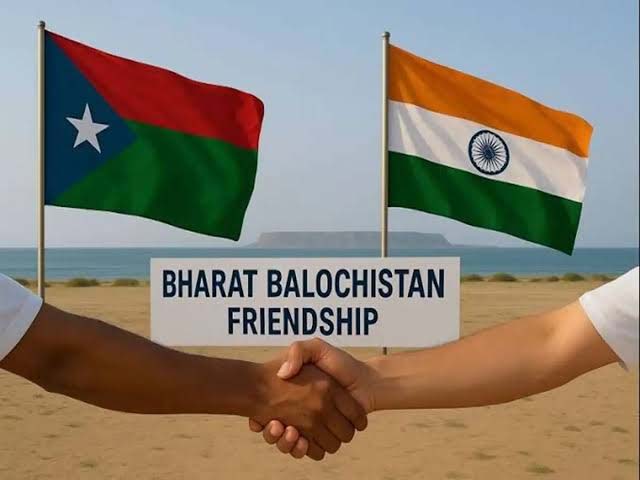
Mir Yar Baloch invites President Droupadi Murmu and Prime Minister Narendra Modi to establish diplomatic ties, offering cooperation in trade, energy, maritime security and connectivity with Central Asia
NEW DELHI: The Republic of Balochistan has formally appealed to the Government of India to recognise it as an independent state and establish diplomatic relations, proposing a strategic partnership spanning trade, energy security, maritime connectivity, counter-terrorism and technological cooperation.
In a communication addressed to President Droupadi Murmu and Prime Minister Narendra Modi, Mir Yar Baloch, representative of the Republic of Balochistan, called upon New Delhi to open diplomatic dialogue with Baloch leadership and extend support for Balochistan’s international recognition.
The appeal highlights Balochistan’s strategic geographical position along the Arabian Sea, its estimated 770-kilometre coastline, deep-water ports and substantial mineral and energy resources as potential foundations for a mutually beneficial partnership with India.
Referring to Prime Minister Modi’s 2016 Independence Day address from the Red Fort, in which he mentioned Balochistan, the communication urged India to translate that expression of concern into concrete diplomatic engagement during his third term.
Strategic gateway to Afghanistan and Central Asia
The proposal identifies Balochistan as a potential trade and transit corridor connecting India with Afghanistan, Central Asia and wider international markets.
It argues that access to ports such as Gwadar could offer India additional maritime and commercial options, while reducing dependence on existing regional transit arrangements.
The communication also highlights Balochistan’s natural resources, including copper, gold, natural gas, iron ore, coal, zinc and other critical minerals, as potential areas for long-term economic and industrial cooperation.
Four key areas of proposed cooperation
The Republic of Balochistan has outlined four major areas of partnership with India:
- Trade and transit: Access to Balochistan’s ports and proposed land and sea corridors connecting Afghanistan and Central Asia with Indian markets.
- Energy security: Preferential long-term arrangements for natural gas and other energy resources.
- Security cooperation: Intelligence-sharing and joint efforts against terrorism and extremist networks.
- Technology and education: Partnerships involving Indian universities, hospitals and information technology companies to support institutional development.
Balochistan’s historical claim to sovereignty
The communication presents a historical account of Balochistan’s claim to independence, referring to the 1876 treaty relationship between the Khanate of Kalat and the British Crown.
It states that an agreement reached at a meeting in Delhi on 4 August 1947, attended by Lord Mountbatten, Muhammad Ali Jinnah and the Khan of Kalat, recognised a separate sovereign status for Kalat.
According to the communication, Balochistan declared independence on 11 August 1947, three days before Pakistan came into existence. It further claims that the Kalat parliament rejected accession to Pakistan in December 1947 and February 1948, before Pakistan annexed the territory in March 1948.
The letter describes the events of 1948 as an illegal annexation and maintains that the Baloch people’s demand for self-determination and sovereignty has continued since then.
These historical and legal assertions form part of the Republic of Balochistan’s position presented in the appeal.
Allegations of human rights violations
The communication also alleges that Baloch communities have faced enforced disappearances, resource exploitation, ethnic persecution and political repression under Pakistani administration.
It raises similar allegations concerning Baloch communities living under Iranian rule, including executions, displacement and denial of legal identity.
Three major requests to India
Seeking a new chapter in bilateral engagement, the Republic of Balochistan has placed three principal requests before the Indian Government:
- Diplomatic recognition: Recognise the Republic of Balochistan as an independent state and establish formal diplomatic relations.
- International engagement: Support appropriate observer-level engagement for Balochistan at the United Nations, European Union, Organisation of Islamic Cooperation and African Union, subject to their respective procedures.
- Nation-building partnership: Extend cooperation in education, healthcare, infrastructure, technology, defence and security.
The communication concludes by inviting Indian representatives to meet Baloch leadership at the earliest opportunity to discuss the proposed partnership.
The appeal is signed by Mir Yar Baloch, representative of the Republic of Balochistan, and calls for a relationship based on peaceful dialogue, mutual interests and regional stability.