
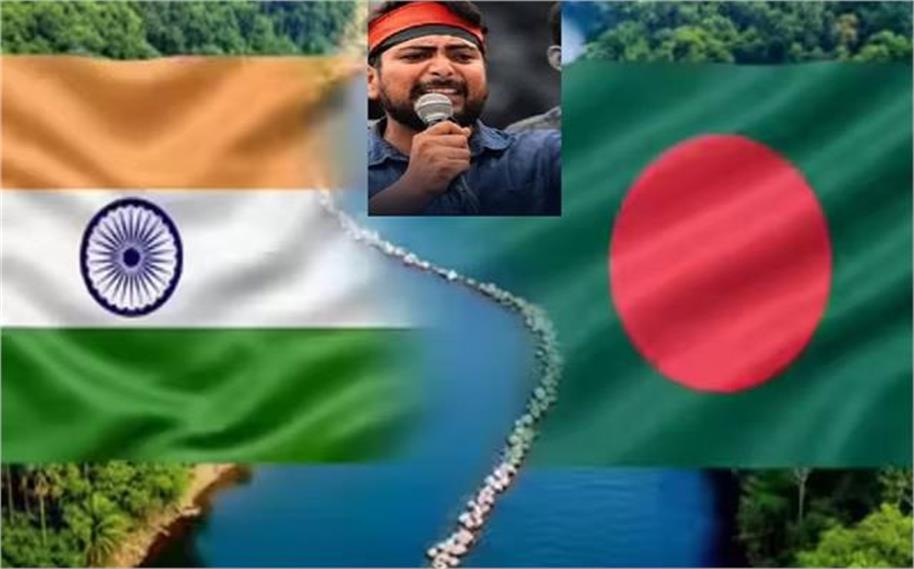
Bangladesh’s National Citizen Party leader Nahid Islam has opposed plans for a proposed Indian transit corridor through Bangladesh, accusing Prime Minister Tarique Rahman’s government of facilitating the project. He has also demanded that Bangladesh’s rightful share of Ganga waters be protected in the renewal of the water-sharing treaty, warning of fresh protests if an agreement is not reached on acceptable terms.
Dhaka: Bangladesh’s opposition leader Nahid Islam has warned that any move to establish an Indian transit corridor through Bangladesh would face resistance. He has also called on the government to secure a fair water-sharing agreement with India before the Ganga Water Treaty expires on 12 December.
Islam, convener of the National Citizen Party (NCP), made the remarks during a rally in Dhaka on Friday. Hundreds of party supporters attended the gathering, which was organised primarily to demand the resignation of Home Minister Salahuddin Ahmed and Power, Energy and Mineral Resources Minister Iqbal Hasan Mahmud Tuku.
Tuku has faced criticism over allegations that the authorities have failed to maintain law and order and tackle shortages of gas and electricity.
Addressing the gathering, Islam accused Prime Minister Tarique Rahman’s government of attempting to facilitate an Indian transit corridor through Bangladesh. He warned that the public would oppose any such arrangement.
According to reports by Bangladeshi newspaper Prothom Alo and news portal BDNews24, Islam also threatened to organise fresh demonstrations if the Ganga water-sharing agreement was renewed without safeguarding Bangladesh’s interests.
The National Citizen Party was established in February 2025 by leaders of the student movement that spearheaded the July-August 2024 protests. The demonstrations eventually led to the removal of then Prime Minister Sheikh Hasina from office.
Nahid Islam raises objections over proposed transit corridor
According to BDNews24, Islam alleged that Japan was once again seeking to establish a corridor through Bangladesh and that the government was attempting to transfer control of the proposed route to India.
He said, “Japan is once again trying to establish a corridor through Bangladesh. The government is attempting to hand over this illegal corridor to India. Prime Minister Tarique Rahman, we want to make it absolutely clear that the people of Bangladesh will not accept any such illegal corridor.”
Prime Minister Tarique Rahman visited Japan from 26 to 29 October. During the visit, Bangladesh and Japan agreed to transform their Bay of Bengal Industrial Growth Belt initiative into a broader strategic cooperation framework.
The proposed framework focuses on improving regional connectivity, strengthening preparedness for natural disasters and geopolitical risks, promoting public-private partnerships to support economic development, and expanding cooperation for regional peace and stability.
Japan is also providing financial and technical support through its development agency, the Japan International Cooperation Agency (JICA), for the development of the Matarbari deep-sea port in south-eastern Bangladesh.
Bangladesh denies discussing any third country with Japan
Amid the controversy surrounding the proposed connectivity arrangements, Bangladesh’s State Minister for Foreign Affairs, Humayun Kabir, said on Friday that no third country had been discussed during Rahman’s visit to Japan.
According to The Dhaka Tribune, Kabir told reporters, “We made it absolutely clear… there was no mention of any third country. We did not go there to discuss the Bay of Bengal, because the Bay of Bengal does not belong to us alone.”
Meanwhile, on 28 October, India reiterated its intention to strengthen its strategic partnership with Japan, including through initiatives involving India’s north-eastern states.
The statement followed an agreement between Bangladesh Prime Minister Tarique Rahman and Japanese Prime Minister Sanae Takaichi to expand regional connectivity. The two leaders also signed agreements providing for additional Japanese assistance towards Bangladesh’s Matarbari deep-sea port project.
Responding to developments, India’s Ministry of External Affairs spokesperson Randhir Jaiswal said in New Delhi that India shared a strong partnership with Japan and was keen to expand cooperation further.
He said, “We have a very strong partnership with Japan. We also have several initiatives involving our north-eastern states and Japan, and we want to strengthen these ties further.”
Ganga Water Treaty renewal becomes another point of contention
Apart from the proposed transit corridor, Islam also raised concerns over the Ganga Water Sharing Treaty between India and Bangladesh, which is due to expire on 12 December.
He demanded that any renewed agreement guarantee Bangladesh a fair share of the river’s water and warned that the failure to secure acceptable terms could trigger fresh protests.
According to BDNews24, Islam said, “This time, we will not give up even an inch of our rightful share under the Ganga Water Treaty.”
His remarks have brought the proposed transit corridor and the future of the Ganga water-sharing agreement into focus as two important issues in India-Bangladesh relations.