
Indian-Americans are contesting US midterm races while community groups back candidates sympathetic to Hindu concerns. The effort reflects a push for stronger representation and broader influence across American politics.
Indian-Americans are seeking not only a greater share in political power in the US by contesting elections, but are also backing candidates seen as sympathetic to the community and Hindu concerns in the November 3 midterm polls. The elections will decide all 435 seats in the House of Representatives, about one-third of the 100-member Senate, and also cover several contests for governors, state legislatures, mayors and other local offices.
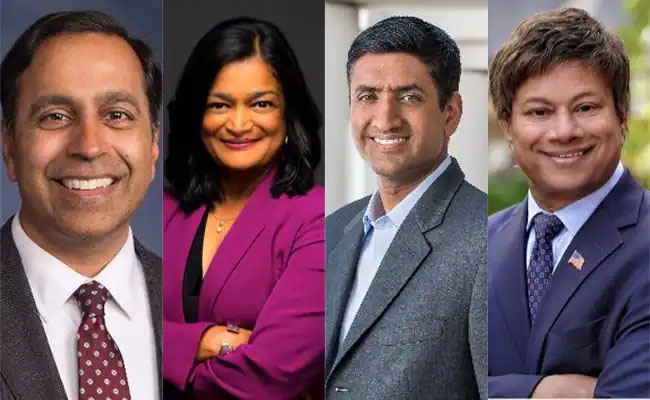
The outgoing House has six members of Indian origin, but that number is likely to fall to four after Raja Krishnamoorthi of Illinois and Shri Thanedar of Michigan failed to clear their primaries. Indian-American Congresspersons Ro Khanna from California’s 17th district, Pramila Jayapal from Washington’s 7th, Ami Bera from California’s 3rd and Suhas Subramanyam from Virginia’s 10th are now up for re-election.
Amish Shah, an emergency medicine physician, is the Democratic nominee from Arizona’s 1st district for the US Congress, while Pia Dandiya is in the fray from Florida’s 22nd district. Five-term Congressman Krishnamoorthi had aimed to become the first Hindu US Senator from Illinois, but lost the Democratic primary to Juliana Stratton in March. Thanedar lost the Michigan primary for the 13th Congressional district to Donavan McKinney, who was backed by the Democratic Socialist Alliance, a group described as having gained considerable influence within the Democratic Party.
Republican Vivek Ramaswamy, a biotech entrepreneur-turned-politician, is contesting for Ohio Governor. Endorsed by US President Donald Trump, Ramaswamy is facing headwinds in his campaign against Democratic nominee Amy Acton.
Romesh Japra, a California-based cardiologist who founded the Americans4Hindus Political Action Committee, said backing only Indian-American candidates was not enough. “It is not enough to support Indian-Americans in the elections. We also need to support those sympathetic to the Indian diaspora and Hindus,” he told PTI. He said the PAC is supporting Democrats James Walkinshaw from Virginia’s 11th district, Suzan DelBene from Washington’s 1st, Pia Dandiya from Florida’s 22nd and Gregory Meeks from New York’s 5th in the House elections. It has also backed Republican candidates Jenny Rae Le Roux from California’s 47th district for the House and incumbent US Senator James Risch.
Ajay Jain Bhutoria, a former White House adviser during President Joe Biden’s tenure, said Indian-American candidates should broaden their appeal. “My advice to Indian-American candidates is that they should look at issues beyond the diaspora and focus on the aspirations of the Congressional districts they seek to represent,” he said.
Community leaders said Indian-Americans have a strong presence in states such as California, Texas, New Jersey, New York, Washington, Illinois, Pennsylvania and Georgia. Japra said even a one or two per cent vote share could swing the result in battleground states such as Georgia, Pennsylvania, Michigan and North Carolina. Besides Congressional races, Republican leader Sarita Komatireddy is challenging Democrat Letitia James for New York Attorney General. Although New York is seen as a Democratic stronghold, Komatireddy, who has been endorsed by Trump, made her mark in the pre-election debate with James.
In Maryland, Hyderabad-born Lieutenant Governor Aruna Miller is seeking re-election. Kerala-born Nithya Raman, a Democrat, is in the fray for the post of Los Angeles Mayor against her one-time mentor and incumbent Karen Bass. Stressing the need for wider political participation, Japra said, “The American Hindu community has a sizeable presence in the US. We have to have a seat at the decision-making table, or else we will end up being on the menu,” adding that public office should be pursued from school boards to the US Senate.
Community leaders also said that despite their strong presence in states such as California and Texas, Indian-Americans have often lost representation because of divisions within the community. “There have been instances of multiple Indian-Americans contesting elections against each other, which has resulted in the victory of a candidate from a numerically weaker community,” a diaspora leader said, stressing the need for unity to remain politically relevant. Overall, Indian-Americans are entering the midterm elections both as candidates and as organised supporters, while trying to strengthen their influence across elected offices in the US.
With PTI Inputs