
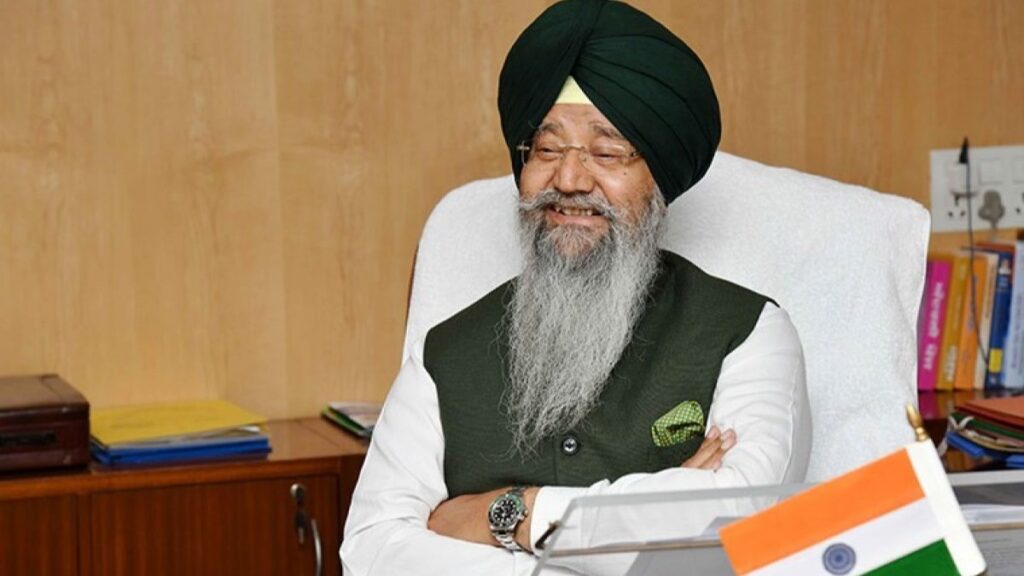
Dr. Iqbal Singh Lalpura
Punjab is a proud border state, sharing approximately 550 kilometres of international border with Pakistan. Its geographical location has always given it a special security responsibility. Since Partition, cross-border smuggling has remained a challenge, and over the decades the nature of this threat has changed. What once involved the smuggling of weapons and other contraband increasingly became connected with narcotics.
During the years of militancy, Punjab faced the grave challenge of terrorism supported from across the border. The people of Punjab, along with the police, paramilitary forces and armed forces, made enormous sacrifices in defeating terrorism. Punjab’s people stood as an important line of support for the national security forces. After conventional attempts to destabilise Punjab through terrorism failed, the narcotics trade increasingly became a means of creating social and economic damage. Drug trafficking also generated illegal wealth for criminal networks.
The threat today is therefore not merely a problem of addiction. It has dimensions of national security, organised crime, cross-border smuggling, money laundering, corruption, public health and the future of Punjab’s youth.
The seriousness of the problem was already being recognised more than two decades ago. A 2003 report concerning a Punjab IPS Officers Association seminar quoted the then Chief Minister, Capt Amarinder Singh, expressing concern over the spread of drug abuse and challenging IPS officers to identify even one village free from the problem. The report also referred to a study in Ludhiana in which 67 per cent of boys and 52 per cent of girls surveyed were reported to have tried drugs. These figures were reported at the time and should be understood in the context and methodology of that particular study.
The same period provides an important part of my own experience as Senior Superintendent of Police, Tarn Taran. In November 1997, following intelligence regarding an expected consignment, the Tarn Taran police seized 83.6 kg of heroin. The contemporary newspaper report described it as the biggest-ever heroin seizure by the district police at that time. The report also referred to other major seizures made during my tenure, including 36 kg of heroin and, in a joint operation with the Narcotics Control Bureau, 55 kg of heroin and 22 kg of opium.
The report stated that I was transferred from Tarn Taran shortly after the major seizure and that the reasons for the transfer were not given. It also stated that the police team had not received certain rewards despite convictions in major cases. These are matters recorded in the contemporary newspaper report and remain part of the history of Punjab’s fight against narcotics.
The larger lesson is important. An honest police officer who takes on organised narcotics networks must receive institutional protection and encouragement. If officers believe that strong action against influential traffickers may result in harassment, arbitrary transfers or professional uncertainty, the entire enforcement system is weakened.
Unfortunately, the issue of institutional protection has not disappeared.
In February 2026, The Times of India reported that Special Director General of Police Harpreet Singh Sidhu, a 1992-batch Punjab-cadre IPS officer and former head of Punjab’s Anti-Drug Special Task Force, had been awaiting a posting for nearly five months after returning to the state from central deputation. The report noted his earlier role in developing Punjab’s anti-drug strategy and his work involving enforcement, de-addiction and prevention.
Whatever the administrative reasons for any particular posting may be, a larger principle deserves attention, a senior officer who has worked extensively against the drug trade should not be left in a situation where there is a perception of professional harassment or uncertainty because of his anti-drug work. Administrative decisions must be transparent, lawful and based on public interest.
The Punjab and Haryana High Court has also, over several years, examined allegations concerning a nexus between sections of law enforcement and drug traffickers. In proceedings initiated after concerns raised by retired IPS officer Shashi Kant, the Court examined reports concerning the alleged involvement of police personnel and directed investigation into the role of police officers, however highly placed, who might have assisted drug trafficking.
The Court record also dealt with the case of dismissed police officer Inderjit Singh and allegations concerning his links with drug traffickers. The Court emphasised the need to examine the role of other officials and to break any nexus between law-enforcement agencies and drug traffickers. These were allegations and investigative findings in particular proceedings,they should not be generalised to the entire Punjab Police.
This brings us to another important question ,where are the major traffickers?
A 2003 Tribune report on the alleged nexus among cops, drug smugglers and politicians reproduced a list of proclaimed offenders under the NDPS Act, naming Harpal Shah, Gurdeep Singh, Suba Singh, Punjab Singh, Major Singh, Kanwarjit Singh Sandhu, Pargat Singh, Gurnam Singh and Charanjit Singh, among others.
That list is a historical record from the 2003 report. It should not be represented today as proof that every person named remains at large in 2026. Their present legal status would have to be established from current police, court and government records. But the historical question remains legitimate , how many major traffickers identified over the years were actually brought to justice, how many cases resulted in conviction, how many assets were confiscated, and how many networks were genuinely dismantled?
The answer to those questions is far more important than the number of small arrests.
The Punjab Government has reported very large enforcement figures under its present anti-drug campaign. According to figures reported in September 2026, between March 2025 and September 2026, 61,824 FIRs were registered and 81,433 people were arrested under the NDPS Act, with reported seizures including 3,918 kg of heroin, 991 kg of opium, 47 tonnes of poppy husk, 1,416 kg of ganja and 65 lakh tablets and capsules.
These numbers demonstrate the scale of enforcement. But arrests alone cannot be the final measure of success. The real test is whether the kingpins, financiers, suppliers, transporters, money launderers and protectors are identified and prosecuted, whether their properties and proceeds of crime are confiscated through due legal process ,whether convictions survive judicial scrutiny and whether the supply of drugs actually decreases.
The Government of India has now placed the fight against drugs within a broader national framework. Under the Drug-Free India 2029 roadmap, the Centre has identified 272 vulnerable districts, including 73 classified as ultra-sensitive. Six Punjab districts :- Amritsar, Gurdaspur, Tarn Taran, Ferozepur, Fazilka and Ludhiana ,have been placed in the ultra-sensitive category. The national plan includes dismantling major drug networks, bringing fugitives back to India, strengthening financial investigations, improving border surveillance and expanding de-addiction facilities.
The strategy announced by the Centre is based on four broad pillars: intelligence- and operations-based enforcement; control of synthetic drugs and precursor chemicals; demand reduction and harm reduction; and capacity building and coordination among agencies. Its stated operational approach is to detect, disrupt and destroy drug networks.
Punjab needs this coordinated approach.
First, the supply chain must be attacked from the top. Every major seizure should lead to a financial investigation. The police and central agencies must identify the source, transporter, financier, distributor and beneficiaries. The proceeds of narcotics trafficking must be traced and confiscated according to law.
Second, the international border must receive continuous technological strengthening. Drones have transformed cross-border smuggling. Anti-drone technology, surveillance systems, intelligence sharing and coordination between the BSF, Punjab Police, NCB, ED and other agencies must be strengthened.
Third, the system must protect honest officers and act firmly against corruption. If any police officer or public servant is found, after due investigation and judicial process, to have assisted drug traffickers, the law must apply regardless of rank or influence. At the same time, allegations must not substitute for evidence, and every accused person must receive due process.
Fourth, prevention must begin in schools, colleges and villages. Parents, teachers, religious institutions, sports organisations and community leaders must become partners in the campaign. Young people need education, employment, sports, counselling and opportunities to build a meaningful life.
Fifth, addiction must be treated as a health and family crisis. The trafficker who profits from addiction and the young person trapped in addiction cannot be treated in exactly the same manner. Enforcement must be uncompromising against organised trafficking, while those suffering from addiction require treatment, rehabilitation and social reintegration.
The political commitments made over the years must also be examined through measurable results. Congress governments, the previous SAD ,governments and the present Aam Aadmi Party government have all faced the drug challenge in different periods, and political parties have made different promises about addressing it. Claims of success or failure should ultimately be tested against transparent data, convictions, recoveries, treatment outcomes and the dismantling of organised networks.
The Bharatiya Janata Party has now made a clear political commitment on this issue. In September 2026, the Punjab BJP announced its statewide Nasha Mukt Punjab Yatras, covering all 117 Assembly constituencies, and publicly pledged to eradicate the drug menace in Punjab within two years of forming a government. The party has described this as a commitment to make Punjab drug-free and has linked the state campaign with the Union Government’s national target of a drug-free India by 2029.
This commitment should be judged by implementation and measurable outcomes if the BJP forms the government. A promise to make Punjab drug-free must mean more than increasing arrests. It must mean breaking the entire narcotics ecosystem—from the international supplier to the local peddler, from the financier to the money launderer, and from the criminal network to anyone providing protection.
The BJP has also pointed to its record of taking major national security decisions and has presented the fight against drugs as part of its broader national mission. The party’s current stated commitment is that Punjab can be made drug-free within two years of a BJP government taking office, while the Union Government’s stated national objective is a drug-free India by 2029.
For Punjab, however, the objective should rise above party politics.
We have lost too many young lives. Too many families have suffered. Too many mothers have watched their children fall into addiction. Too many villages have seen the social consequences of narcotics. Punjab cannot afford another decade of promises without measurable outcomes.
The people of Punjab deserve a system in which the small peddler is not made the scapegoat while the real financiers and kingpins remain beyond reach. They deserve a police force where an honest officer is protected, not harassed. They deserve an administration where allegations of political or bureaucratic protection are investigated independently and transparently. And they deserve a rehabilitation system that gives a person recovering from addiction a genuine opportunity to return to a productive life.
The time has come to make the fight against drugs a permanent national and Punjab mission.
The BJP has made a public promise to make Punjab drug-free within two years of forming the government, alongside the national commitment of a drug-free India by 2029. That promise now needs to be converted into a clear, measurable programme with annual targets for seizures, convictions, financial investigations, confiscation of criminal assets, dismantling of major networks, border interdiction, prevention and rehabilitation.
Punjab has defeated terrorism. Punjab has repeatedly shown courage in defending the nation.
Punjab can defeat the drug menace too,but only when the entire chain is attacked, honest officers are protected, the big traffickers are pursued, addiction is treated, and political promises are measured by results.
Govt of India.