
Mazloum Abdi announced the SDF’s dissolution after its merger with the Syrian army. The move strengthens Damascus’s push to reunify Syria while testing its promises to the Kurds.
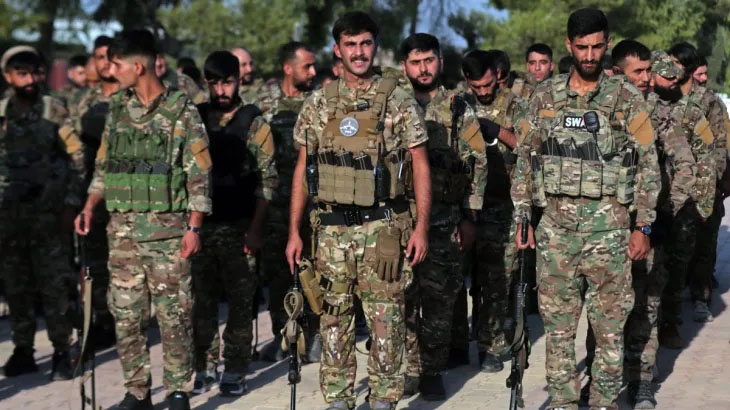
Syria’s Kurdish-led Syrian Democratic Forces, or SDF, on Tuesday announced its official dissolution after completing a merger with the Syrian army, marking the end of the force as an independent military organisation. The decision comes after the group lost most of its territory in north-eastern Syria during a government offensive in January and later signed an agreement to join the army.
Speaking at a news conference at the presidential palace in Damascus, SDF commander Mazloum Abdi said the force had fulfilled its role during a difficult period in the country’s conflict and that Syria had now entered what he described as a new phase. The SDF had earlier been the main US partner in Syria in the fight against the Islamic State group, but the political landscape changed after former President Bashar Assad was ousted in December 2024 and Washington developed close ties with the new government led by interim President Ahmad al-Sharaa.
Abdi said the SDF had “carried a heavy responsibility during one of the most difficult periods in Syria’s history”. He added: “Today, circumstances have changed, and the country has entered a new phase, one of peace and participation in building a new Syria,” as he announced the “end of the SDF’s mission” and “its dissolution as an independent military force”.
Under the 50-year rule of the Assad dynasty, Kurds in Syria were marginalised and many were denied citizenship. Public celebrations of Nowruz, the ancient spring new year festival observed by Kurds and others in the region, were banned. After the uprising against Assad began in 2011, Kurdish forces moved into areas in the north-east after government troops withdrew, and the SDF at one point controlled about a quarter of Syria.
The Kurds were initially cautious about the post-Assad authorities and reluctant to give up their de facto autonomy. Some insurgent groups involved in the offensive that removed Assad were backed by Turkey and had previously fought the SDF. Turkey viewed the SDF as a terrorist organisation because of its links to the Kurdistan Workers’ Party, or PKK, which fought a long insurgency in Turkey, though a peace process is now under way.
There were also doubts among Kurds over whether the new Sunni Arab-led leadership would offer them meaningful representation, even as al-Sharaa sought to reassure them. During ceasefire talks with the SDF in January, he issued a decree expanding Kurdish rights. It made Kurdish an official language alongside Arabic, declared Nowruz a national holiday, and restored the citizenship of tens of thousands of Kurds in the north-eastern Hassakeh province who had lost it in the 1962 census. Abdi said al-Sharaa had also promised that Kurds would have the right to education in their own language.
Questions remain over the future of the SDF’s all-female fighting units, an issue in the integration talks because many leaders in Damascus come from conservative backgrounds and oppose women in combat. Even so, the deal with the SDF comes as an important step for al-Sharaa’s government, which has struggled to unify Syria as the country begins to recover from nearly 14 years of civil war. Most of Syria is now under the control of the central government.
The main exception is the southern province of Sweida, which is controlled by Druze factions hostile to Damascus after clashes last year in which government-affiliated fighters carried out sectarian revenge attacks on Druze civilians. The Druze factions have received support from Israel, which also occupies a strip of land in southern Syria near the border with the Israeli-annexed Golan Heights. With the SDF now dissolved and merged into the army, the Syrian government has taken another step towards bringing more of the country under central authority.
With PTI Inputs