
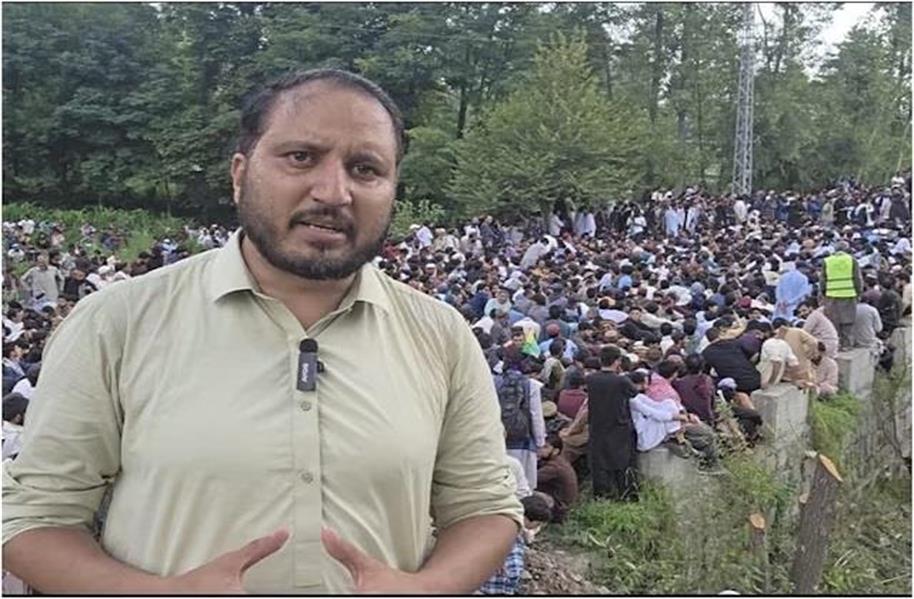
Islamabad: Pakistan’s alleged crackdown on independent journalism in Pakistan-occupied Kashmir (PoK) has come under renewed scrutiny after journalist and researcher Danish Irshad, who has been reporting on protests and security forces’ actions, was reportedly placed on the country’s terrorism-related ‘Fourth Schedule’ watchlist.
The move has raised serious questions over whether Pakistan is using counter-terrorism powers to silence uncomfortable reporting. According to reports, Irshad now faces restrictions affecting his movement, financial activities and foreign travel. No public court verdict establishing his involvement in terrorism has been reported.
Irshad has spent nearly a decade covering political and social developments in PoK and Gilgit-Baltistan. He began his journalism career in Islamabad in 2015 and has been associated with Lahore-based Neo News. He has also written columns for the Jammu-based Kashmir Times and authored a book examining the history of Jammu and Kashmir after 1947.
His recent reporting has focused heavily on protests in PoK, the conduct of security forces and the impact of the unrest on civilians and their families. Irshad said he discovered on 18 August through social media that his name had been added to the Fourth Schedule and later confirmed the information through a source in the PoK Home Department.
Reports claim that his name appears at number 12 on a list of 24 wanted individuals in PoK. The action reportedly also covers activists associated with the Jammu and Kashmir Joint Awami Action Committee (JAAC). Irshad maintains that he has neither been produced before a court in connection with any case nor convicted of any offence. Pakistan’s authorities have not publicly explained in detail why he has been subjected to the measure.
Journalism Treated as a Security Threat?
Pakistan’s Fourth Schedule operates under counter-terrorism legislation and can subject designated individuals to surveillance and a range of restrictions. These may include travel curbs, monitoring of financial transactions and difficulties accessing banking services.
The controversy lies in the apparent use of such sweeping security powers against a journalist whose recent work has centred on documenting politically sensitive events. Critics argue that turning a reporter into a security-list subject without a publicly disclosed conviction risks sending a chilling message to journalists across PoK: report too closely on the authorities and face the consequences.
The action comes amid sustained protests in PoK led by the JAAC. Demonstrators have raised demands concerning political representation, subsidies, governance and local rights. Among their demands is the abolition of 12 reserved seats in the PoK Assembly allocated to Kashmiri refugees settled in Pakistan.
Pakistan banned the JAAC on 5 June, after which tensions between protesters and security forces reportedly escalated. Reports have also cited internet shutdowns and restrictions affecting media activity during the unrest.
Irshad has continued reporting on the security response, protesters and families affected by the demonstrations. The JAAC claims that more than 80 civilians were killed during security forces’ actions. Those figures and allegations remain claims by the organisation and require independent verification.
Press Freedom Under Pressure
Pakistani journalist Saleh Safeer Abbasi described the development as a serious issue for press freedom, arguing that disagreement with the government should not itself amount to a crime.
Pakistani activist Azhar Ahmed, based in Britain, questioned whether deploying counter-terrorism legislation against a journalist could foster fear among reporters and undermine independent journalism.
New York-based Pakistani investigative journalist Ariba Fatima also questioned the basis for placing Irshad under a terrorism-related monitoring mechanism in the absence of a publicly disclosed trial or court verdict.
The controversy has therefore moved beyond the case of one journalist. It has fuelled a wider debate over Pakistan’s treatment of dissent, press freedom and the increasingly hard-edged use of security laws against voices documenting unrest in PoK.
For critics, the message from Islamabad is deeply troubling: when reporting exposes unrest, official action and public grievances in PoK, the journalist can end up being treated not as a watchdog, but as a security threat.