
By Dr. Iqbal Singh Lalpura
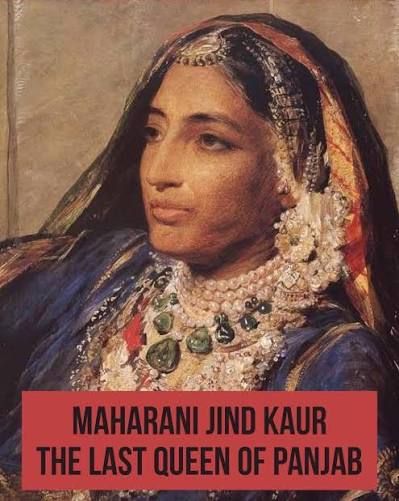
Among the countless heroes and heroines of India’s freedom struggle, there are some whose sacrifices have not received the recognition they deserve. One such extraordinary personality is Maharani Jind Kaur, the youngest queen of Maharaja Ranjit Singh, the mother of Maharaja Duleep Singh, and the last Regent of the Sikh Empire. While Indian history has rightly celebrated many champions of freedom, Maharani Jind Kaur remains one of the most overlooked figures despite the fact that the British Empire itself regarded her as one of its most dangerous adversaries.
Her life was not merely the story of a queen defending a kingdom. It was the story of a fearless woman who refused to surrender the sovereignty of her nation, challenged the mightiest empire of her time, endured imprisonment and exile, and inspired generations with her indomitable courage. Long before the organised freedom movement of the twentieth century, Maharani Jind Kaur had become a symbol of resistance against colonial domination.
The evidence of her importance comes not from folklore alone but from British official records. Confidential correspondence of the East India Company, reports of senior administrators, intelligence documents, and letters written by Governor-General Lord Dalhousie consistently portray Maharani Jind Kaur as the greatest political challenge facing British authority in Punjab after the death of Maharaja Ranjit Singh.
Lord Dalhousie, the architect of British expansion in India, famously remarked:
“She has the only manly understanding in the Punjab.”
This oft-quoted observation was never intended as praise. It reflected the anxiety of a colonial administration that recognised in Maharani Jind Kaur a leader possessing remarkable political judgement, determination, and the ability to unite people against foreign domination. To the British, she represented far more than a widowed queen; she embodied the continuing legitimacy of the Sikh Empire.
Following the death of Maharaja Ranjit Singh in 1839, the Sikh Empire entered a period of political instability. Court intrigues, assassinations, factional rivalries, and increasing British interference threatened to weaken one of the strongest indigenous powers in Asia. Amidst this turmoil emerged Maharani Jind Kaur, determined to safeguard the empire for her young son, Maharaja Duleep Singh.
Assuming the regency required exceptional courage. She was not merely protecting her son’s throne but defending the independence painstakingly built by Maharaja Ranjit Singh. She addressed assemblies of Sikh chiefs, encouraged unity among the Khalsa, and sought to prevent British interference in Punjab’s internal affairs. Her political abilities surprised even those who underestimated her because of her gender.
British officers carefully documented these efforts. Sir Henry Lawrence acknowledged that all her actions were directed towards restoring an independent government in Punjab. Sir Frederick Currie described her as “the rallying point of rebellion.” Other officials warned London that she remained “a serious obstacle to British rule in India” and “a threat to British power.” Such descriptions reveal the extraordinary respect—and fear—with which British authorities regarded her.
The Second Anglo-Sikh War ended in 1849 with the annexation of Punjab into the British Empire. Militarily victorious, the British nevertheless remained uneasy. They understood that conquering territory was easier than conquering the spirit of its people. As long as Maharani Jind Kaur remained free, she possessed the moral authority to inspire resistance throughout Punjab.
Lord Dalhousie repeatedly expressed concern that her return to Punjab could ignite another uprising. Consequently, the British adopted extraordinary measures to isolate her from her people. She was first confined at Sheikhupura and later transferred to the heavily guarded Chunar Fort near Banaras. Her correspondence was intercepted, visitors were restricted, and every aspect of her daily life was monitored.
British intelligence records reveal that officers such as Captain Lumsden, Lieutenant Hodson, and others maintained constant surveillance. Their reports demonstrate an almost obsessive concern over her influence. They feared that even in captivity she remained capable of mobilising support among Sikhs and rekindling the spirit of independence.
Yet the event that most humiliated the British administration occurred on the night of 19 April 1849.
Against seemingly impossible odds, Maharani Jind Kaur escaped from Chunar Fort, one of the most secure prisons under British control. Travelling in disguise through unfamiliar territory, avoiding British patrols and informers, she undertook an arduous journey of nearly five hundred kilometres before reaching Kathmandu in Nepal.
Her escape immediately became an embarrassment for the East India Company. British officials rushed to investigate how such a closely guarded prisoner could simply disappear. The inquiry itself revealed the profound respect she commanded. Several reports admitted that prison officials had gradually become sympathetic towards her, while local residents admired her courage and dignity.
When officers entered her room after discovering her disappearance, everything remained perfectly arranged. On her bed lay a letter written in Persian. Nearby were a few coins left deliberately on the floor.
Historian Christy Campbell records that the Maharani left the coins as payment for the “hospitality” she had received during her imprisonment. The gesture was deeply symbolic. It mocked the authority of the British Empire and transformed her escape into a moral victory over her captors.
Her letter carried an even more powerful message:
“Do not imagine that I have fled. Know well that I have departed by my own strength and determination, without anyone’s assistance.”
Those words reflected the confidence of a sovereign ruler rather than the desperation of a fugitive. They conveyed that she had escaped not through fortune but through courage, planning, and unshakeable resolve.
Her arrival in Nepal created a diplomatic crisis. The British immediately demanded that the Nepalese authorities arrest and hand her over. Kathmandu suddenly found itself balancing relations with an expanding colonial empire while confronting the moral responsibility of protecting a dispossessed queen seeking refuge.
Maharani Jind Kaur met King Rajendra Bikram Shah and the influential Prime Minister Jung Bahadur Rana. Although British pressure remained intense, Nepal eventually granted her political asylum. The British never succeeded in forcing her extradition. Even in exile, she remained beyond their grasp.
The eleven years she spent in Nepal were marked by loneliness and declining health. The emotional burden of imprisonment, separation from Punjab, and constant uncertainty gradually weakened her physically. Her eyesight deteriorated until she was almost completely blind.
In 1861 she was finally reunited with her son, Maharaja Duleep Singh, in Calcutta after years of separation. It was an intensely emotional meeting. The son recognised the mother he had lost as a child, while the nearly blind Maharani recognised her son only by touching his face.
Tradition records that when she realised that Duleep Singh’s unshorn Sikh hair had been cut following his removal from Punjab and his upbringing under British influence, she exclaimed that the sorrow of losing her husband and her kingdom had been less painful than seeing her son’s sacred identity taken from him. Whether recorded verbatim or preserved through oral tradition, the episode illustrates the profound importance she attached to Sikh identity and sovereignty.
Mother and son later travelled to England. Although physically frail and nearly blind, Maharani Jind Kaur remained spiritually unconquered. She passed away on 1 August 1863, far from the Punjab she had struggled so valiantly to defend.
Even after her death, British narratives attempted to diminish her legacy. Sections of the colonial press labelled her “Messalina of the Punjab,” “The Rebel Queen,” and “the woman who terrified the British Empire.” Such descriptions reflected a familiar colonial strategy: discredit those leaders who could not be defeated morally or politically.
Fortunately, history is ultimately judged not by propaganda but by evidence. The official records of the British administration leave little doubt that Maharani Jind Kaur was regarded as one of the most formidable opponents of British expansion in India. Their own correspondence repeatedly acknowledged her leadership, her political judgement, and her extraordinary influence over the people of Punjab.
Today, as India honours the countless men and women who contributed to the nation’s freedom, Maharani Jind Kaur deserves a far more prominent place in our collective memory. She resisted colonial domination decades before the rise of organised nationalist movements. She suffered imprisonment, exile, separation from her child, and the loss of her eyesight, yet she never surrendered her faith in freedom or her commitment to the sovereignty of her people.
Her story is especially relevant for modern India. At a time when discussions of women’s leadership often focus on contemporary achievements, Maharani Jind Kaur reminds us that nearly two centuries ago an Indian woman stood fearlessly before the most powerful empire in the world and refused to submit. She demonstrated that courage is not determined by gender, that leadership is measured by conviction, and that sacrifice for one’s nation transcends time.
For the Sikh community, she remains a symbol of resilience, dignity, and unwavering commitment to the Khalsa heritage. For India, she represents one of the earliest and most powerful voices of resistance against British imperialism. Her legacy deserves to be studied in classrooms, remembered in public discourse, and celebrated alongside the greatest heroes of India’s freedom movement.
On her death anniversary every year, it is not enough merely to pay tribute. We must also restore Maharani Jind Kaur to her rightful place in history, not simply as the Queen of the Sikh Empire, but as one of the earliest, bravest, and most determined freedom fighters of India. The Lioness of Punjab was, indeed, one of the first great lionesses of India’s struggle for freedom, and the woman whom the British Empire feared the most.
Former Chairman
National Commission for Minorities
Government of India