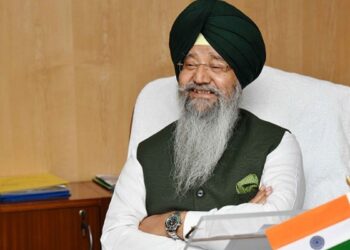

By Dr. Iqbal Singh Lalpura
The strength of a nation is measured not merely by its economic growth, military power, or technological advancement. The true foundation of a civilized society rests upon two timeless virtues—morality and moral courage. Morality enables us to distinguish right from wrong, while moral courage gives us the strength to uphold what is right even when it comes at a personal cost. Nations rise on the strength of character and decline when institutions lose their ethical foundation.
India today stands at a defining moment in its history. As we move towards Amrit Kaal and the centenary of Independence in 2047, the greatest challenge before us is not the lack of talent, resources or opportunity. It is the gradual erosion of morality in public life. Unless ethical conduct once again becomes the guiding principle of our institutions, no amount of economic progress can make India a truly developed nation.
Recently, during proceedings in the Supreme Court on 15 May 2026, the Honourable Chief Justice of India reportedly referred to persons possessing fake law degrees as “cockroaches.” While the frustration behind such an observation may be understandable, referring to any human being in such terms is unfortunate and does not reflect the dignity expected from judicial discourse. Yet the larger question remains. What should society call those who knowingly enter a profession through fraud—a profession entrusted with defending justice, protecting the innocent and assisting the courts? The issue is not the choice of words but the alarming decline of honesty in professions that demand the highest ethical standards.
The recurring leakage of NEET examination papers is another disturbing example of this decline. Such incidents destroy the dreams of deserving students, undermine public confidence and weaken faith in the education system. Every leaked examination paper represents not merely an administrative failure but a moral failure. Merit becomes the first casualty when dishonesty enters the system.
History provides us with inspiring examples of genuine moral courage. I have had the privilege of seeing the Class VIII report card of Shaheed-e-Azam Sardar Bhagat Singh. The British examiner awarded him 48 marks out of 50. Despite ruling India, the examiner recognised merit without prejudice. Bhagat Singh himself became a living example of intellectual honesty and moral conviction. His prison diary reveals not merely the thoughts of a revolutionary but the vision of a nation builder. He willingly embraced death because he believed that truth, justice and freedom were greater than life itself. His sacrifice was the highest expression of morality combined with courage.
The issue of morality in governance is not new. The Lumsden Committee Report of 1925–26 recorded that many government employees had begun treating illegal gratification as a matter of right for rendering public service. The report described in detail the methods through which corruption had become institutionalised. More important than the findings was the courage of the committee members, who honestly documented uncomfortable truths despite the embarrassment such disclosures could cause.
Many Indians have often remarked that the British administrative system appeared more disciplined and efficient. Such observations should not be misunderstood as praise for colonial rule. The real question is why so many Indians lacked the moral courage to refuse unjust orders against their own countrymen. During the freedom struggle, it was often Indian policemen, soldiers and officials who carried out orders to suppress fellow Indians. The tragedy was not merely political; it reflected a failure of moral courage.
An interesting observation is attributed to a departing British administrator before Independence. When asked what would happen to India after the British left, he reportedly replied that British influence would continue for about seventeen years because senior bureaucrats had been trained under British administrative traditions. After another seventeen years, governance would gradually reflect Indian values—with all their strengths and weaknesses.
Having lived through those decades, first as a student and later as a police officer, I can say on oath that there was virtually no culture of paid tuition during my student days. In government service, the overwhelming majority of officers—not every individual, but certainly the majority—were honest, disciplined and professionally committed. The same could largely be said of political workers and elected representatives. Integrity was respected and professionalism was rewarded.
My own experience changed in 1982 when I encountered the first District Police Chief whose reputation for corruption became widely known. That marked the beginning of a gradual transformation. Slowly but steadily, honesty became a liability rather than an asset. Professional competence lost value while unquestioning loyalty to those in power became the preferred qualification for advancement. The “Yes, Boss” culture replaced independent professional advice.
This unhealthy relationship between sections of the political executive and bureaucracy has damaged governance. Many public servants now compromise legal principles to please political superiors, while some politicians expect unquestioning compliance instead of objective professional advice. Bureaucracy exists to uphold the Constitution and the rule of law, not to become an extension of political convenience. When both institutions compromise, governance inevitably suffers.
The consequences are visible everywhere. Recruitment systems repeatedly come under suspicion. Chairpersons and members of Public Service Commissions and Subordinate Services Selection Boards have faced arrests and criminal investigations. Yet structural reforms remain slow and incomplete. Unless recruitment becomes completely transparent, technology-driven and independently audited, public confidence cannot be restored.
I vividly remember that in 1998, a member of a State Subordinate Services Selection Board admitted that a majority of selections were influenced either by monetary consideration or political recommendations. Unfortunately, similar allegations continue to surface even today. Such practices destroy merit, discourage honest candidates and weaken every institution that depends upon competent public servants.
The decline is not confined to the executive alone. Increasingly, questions are being raised about judicial outcomes as well. I find it difficult to understand how, in one case, a constable could eventually supersede an Inspector and rise to become an Inspector General of Police without undergoing the prescribed stages of training and professional development. When the matter reached the highest court, the petition was reportedly dismissed with a brief order. I do not question the authority of the judiciary, whose independence is the cornerstone of democracy, but one is entitled to ask whether justice should not also appear to have been done through reasoned decisions, especially in matters affecting public institutions. When unusual outcomes remain unexplained, public confidence suffers. Morality requires transparency; moral courage demands that difficult questions be answered.
Where, then, is morality?
Public protests against examination paper leaks are entirely legitimate when they seek accountability. However, accountability cannot become selective or politically convenient. During the seventy-nine years since Independence, examination papers have reportedly leaked well over one hundred times under governments led by different political parties. Those who demand resignations today must also ask whether they accepted similar moral responsibility when such incidents occurred during their own tenure.
Even today, reports of examination irregularities continue to emerge. Allegations regarding leaked Pharmacy examination papers in Faridkot deserve a fair, impartial and time-bound investigation. Likewise, questions raised regarding recruitment examinations must be answered transparently. Every deserving candidate has the right to know that the person selected is indeed the person who honestly appeared for the examination. Nothing short of complete transparency can restore public faith.
The larger problem lies within our educational philosophy. Our education system still produces graduates who often aspire primarily to secure government employment rather than become innovators, entrepreneurs, researchers or creators of wealth. Even highly qualified engineers and doctors frequently prepare for the Civil Services because administrative authority is perceived as more prestigious, influential and financially secure. This reflects not merely career preference but a deeper imbalance in our national priorities.
Equally disturbing is the widening gap between religious practice and ethical conduct. India is perhaps one of the most religious societies in the world. We build magnificent places of worship, participate in rituals with devotion and publicly proclaim our faith. Yet morality cannot survive on rituals alone. Every religion teaches honesty, compassion, humility, justice and service. When these values do not guide our daily conduct, religion becomes ceremony rather than character.
Guru Nanak Dev Ji repeatedly emphasised that truth is not merely to be spoken but to be lived. Honest earning (Kirat Karni), truthful conduct and selfless service form the foundation of spiritual life. Similar teachings exist in every great faith. India’s challenge, therefore, is not religious diversity but ethical consistency.
Independent India has witnessed inspiring examples of leaders accepting moral responsibility even when they were not personally guilty. Lal Bahadur Shastri resigned as Railway Minister following a major railway accident, accepting constitutional responsibility. In 1992, Shri Madhavrao Scindia resigned as Civil Aviation Minister following the crash of an Indian Airlines aircraft, although no personal wrongdoing was attributed to him. More recently, Shri Dharmendra Pradhan accepted moral responsibility and stepped down in the wake of the NEET controversy despite there being no finding of personal misconduct. Such actions strengthen democratic accountability rather than weaken it. Likewise, the personal interest shown by the Honourable Prime Minister Shri Narendra Modi in addressing concerns relating to examination reforms deserves appreciation because restoring public confidence requires leadership from the highest level.
India’s future will not be secured merely through ambitious programmes, modern infrastructure or economic statistics. It will be secured when every institution is guided by integrity, professionalism and accountability. Honest recruitment, transparent examinations, independent institutions, fearless bureaucracy, responsible political leadership and an impartial judiciary together form the pillars of a strong democracy.
As India approaches 2047, our aspiration should be to build a nation where morality is not considered weakness and honesty is not treated as a liability. We need leaders who practise what they preach, public servants who place the Constitution above personal gain, professionals who value competence over shortcuts and citizens who reject corruption in everyday life.
The journey towards Viksit Bharat cannot succeed without moral renewal. Economic development may build highways, industries and smart cities, but only morality and moral courage can build trust, justice and national character. India does not merely need ambitious individuals; it needs upright men and women whose integrity becomes the guiding light for future generations. It is not opportunists who shout the loudest in public who will take India to Amrit Kaal; it is those who quietly practise honesty, uphold the law without fear or favour and possess the moral courage to stand alone when necessary.
Only such a nation will truly fulfil the dream of Amrit Kaal and leave behind a legacy worthy of the sacrifices made by countless patriots who gave everything for India’s freedom.
National Commission for Minorities
Government of India