
Political Affairs Researcher | Foreign Policy & Strategic Affairs Analyst | Track-II Diplomacy Strategist
By Rahul Laxman Patil
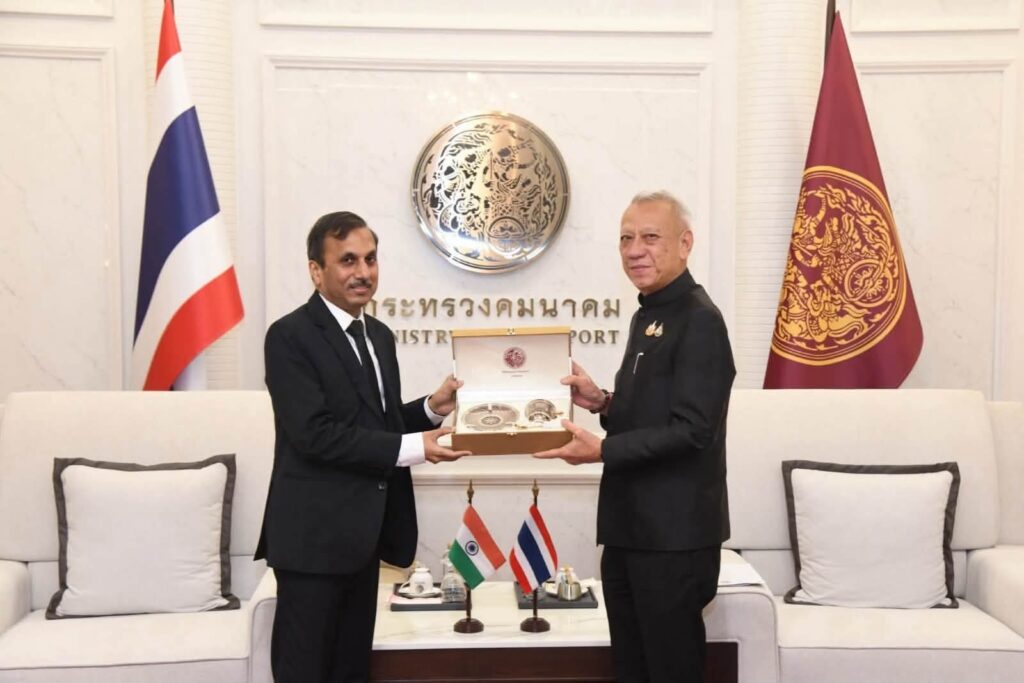
Bangkok: The recent meeting between India’s Ambassador to Thailand, H.E. Mr. Puneet Agrawal, and Thailand’s Deputy Prime Minister and Minister of Transport, H.E. Mr. Phipat Ratchakitprakarn, is best understood as more than a diplomatic courtesy call. It reflects the growing strategic importance of connectivity in shaping economic resilience and regional influence across the Indo-Pacific.
In my assessment, the emphasis on maritime, air, and road connectivity demonstrates that India and Thailand increasingly view transport infrastructure as a strategic asset rather than merely a commercial necessity. As global supply chains evolve, stronger connectivity can enhance trade, investment, logistics, tourism, and business mobility while reinforcing the Bay of Bengal as a vital economic corridor linking South Asia and Southeast Asia.
The dialogue is particularly significant as both countries celebrate the 80th anniversary of diplomatic relations in 2027. While their partnership is rooted in centuries of civilisational ties, Buddhist heritage, and maritime exchanges, it is now evolving towards practical cooperation in infrastructure, commerce, and regional integration.
The meeting also carries wider implications for BIMSTEC. As key members of the regional grouping, India and Thailand have the potential to drive transport connectivity, maritime cooperation, and trade facilitation across the Bay of Bengal. Progress in bilateral connectivity could serve as a catalyst for broader regional integration.
The real significance of the dialogue lies not in the meeting itself but in its strategic direction. If translated into concrete projects and policy coordination, stronger India–Thailand connectivity will strengthen regional supply chains, expand economic opportunities, and contribute to a more integrated, resilient, and prosperous Indo-Pacific.