
Trump has threatened to attack Iran’s Pickaxe Mountain after reports claimed Tehran moved centrifuges to the underground site near its Natanz nuclear facility
US President Donald Trump has threatened to further target Iran’s nuclear facilities amid escalating conflict with the nation. The latest in the list is Pickaxe Mountain area, a fortified underground site.
The Wall Street Journal reported that Israel had provided the US with intelligence suggesting that Iran moved centrifuges to the site. According to the report, Israeli intelligence assessed that Iran transferred centrifuges, which can be used to enrich uranium, an essential process in developing a nuclear weapon, to Pickaxe Mountain last fall.
Why Pickaxe Mountain is significant
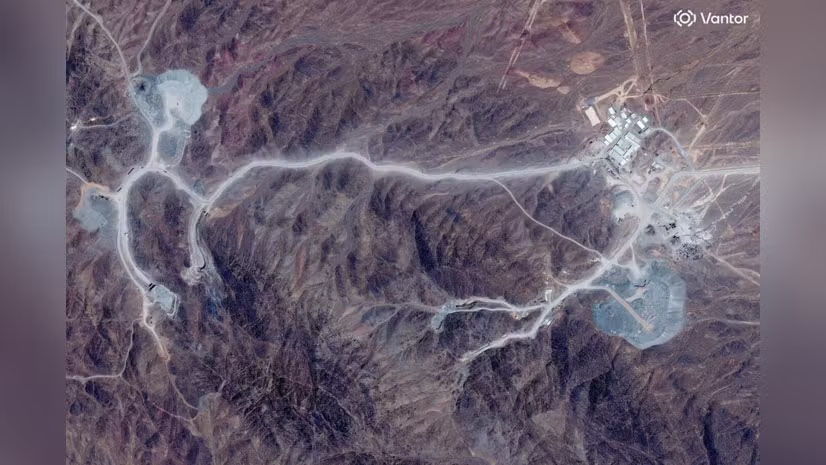
Known as Kūh-e Kolang or Mount Kolang in Iran, Pickaxe Mountain is a nuclear-related underground complex located south of the Natanz uranium enrichment plant. The Natanz site, which houses two of Iran’s uranium enrichment plants, has been bombed multiple times, including during the conflict that began on February 28 this year and the 12-day war in 2025.
The site lies within a large secured perimeter that also includes a smaller tunnel complex originally built in 2007, which was expanded and reinforced in recent years before being sealed shortly after the June 2025 war.
According to the Institute for Science and International Security, a US-based think tank that has analysed satellite imagery of the facility, construction of Pickaxe Mountain began in 2020 following an explosion at the Natanz facility, which Iranian authorities attributed to sabotage.
At the time, Iran announced that the underground halls were intended to replace the destroyed above-ground advanced centrifuge assembly facility at Natanz. The original facility had the capacity to assemble around 6,000 advanced centrifuges annually and was designed to support the large-scale production of centrifuges during and after the gradual phasing out of restrictions under the Joint Comprehensive Plan of Action (JCPOA) between 2025 and 2030.
What has Iran built inside Pickaxe Mountain?
The Institute for Science and International Security says the site features two pairs of tunnel entrances that are assumed to lead to a single underground facility, although the think tank has cautioned that this cannot be stated with certainty.
The complex is estimated to be at least 100 metres beneath the mountain’s surface. The mountain itself stands 1,608 metres above sea level. The difference in elevation between the eastern entrance and the mountain ridge is around 145 metres, while the western entrance sits approximately 100 metres below the ridge. The nearly 50-metre difference between the two sets of entrances has led analysts to suggest that the facility may contain multiple underground levels.
The physical defensive measures at the site primarily consist of a large security perimeter and extensive fortification of its tunnel entrances. According to ISIS, the eastern tunnel entrances have been partially backfilled since the recent conflicts to obstruct ground vehicle access, although they have not been completely sealed. The western tunnel entrances, however, remained open as of July 9, 2026.
According to a Reuters report, strengthening tunnel entrances would significantly complicate any attempt to target the facility using deep-penetrating munitions such as bunker buster bombs.
Is the facility operational and what could it be used for?
The Institute for Science and International Security has assessed that the facility is not yet operational and that construction continues. Based on currently available satellite imagery, it remains unclear when the complex could become functional.
The think tank has also said it is uncertain whether Iran still intends to install a large-scale centrifuge assembly facility there, particularly after recent damage to its centrifuge manufacturing capabilities.
Nevertheless, the think tank believes that if Iran rebuilds its centrifuge manufacturing programme, it could establish a smaller centrifuge assembly facility at Pickaxe Mountain capable of supporting a nuclear weapons programme.
The underground space is also believed to be large enough to house a centrifuge enrichment plant capable of producing weapons-grade uranium. The Institute for Science and International Security has further assessed that the site could potentially accommodate certain nuclear weaponisation activities, including producing weapons-grade uranium metal and shaping it into components used in nuclear weapons.
How difficult would it be to attack the site?
According to a Reuters report, the deeply buried complex is beyond the reach of even the most powerful bunker buster bombs currently in the US arsenal.
The Institute for Science and International Security has suggested that the facility may be more vulnerable to sabotage operations or attacks by ground forces. However, it added that certain vulnerabilities could potentially be exploited through deep earth-penetrating weapons deployed in aerial attacks.
The think tank noted that any military operation could target above-ground power supply lines, ventilation shafts or equipment, as well as the tunnel entrances themselves.
The latest satellite imagery indicates that the western tunnel entrances remain open, leaving them potentially vulnerable to precision-guided strikes or a ground operation entering through those access points. However, airstrikes targeting only the hardened tunnel entrances, without generating shockwaves or blast effects that reach the underground facility itself, would likely only deny Iran temporary access rather than permanently destroy the complex.
US-Iran tensions continue to escalate
Tensions between Washington and Tehran continue to escalate amid ongoing military exchanges. The US military said late Tuesday that it had conducted additional strikes on Iranian military targets, marking an 11th consecutive night of operations. Iran said it had retaliated.
Meanwhile, US Secretary of State Marco Rubio said Iran was not serious about talks and warned against creating a dangerous precedent by allowing Iran to control the Strait of Hormuz.