
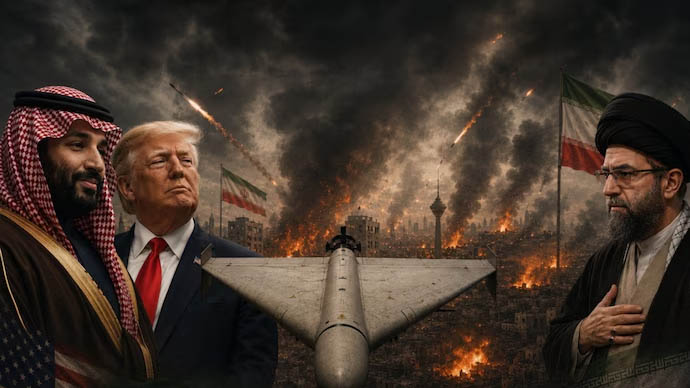
A new battlefield logic is emerging across West Asia, where affordability outweighs sophistication, and swarms may matter more than jets. As states adopt the very systems they once feared, the region edges toward a volatile era of mass-produced aerial power.
West Asia may be entering a more dangerous and more technologically dispersed phase of warfare, one defined less by high-end fighter jets and more by cheap, scalable unmanned systems that can strike deep into critical infrastructure.
The most important lesson drawn from recent Iran-linked conflicts was not only the continued relevance of missiles, but the disruptive impact of low-cost drones. Among them, Iranian-designed Shahed-style systems have emerged as a defining feature of modern regional warfare, reshaping both defensive planning and offensive doctrine across multiple states.
Now, one of Tehran’s principal regional rivals appears to be moving towards adopting a similar model.
A Saudi-US Partnership Anchored in Drone Production
Reports suggest that a new Saudi–US defence initiative is preparing to establish a drone manufacturing facility near Riyadh. The project reportedly involves Utah-based defence firm Vector Defense and Saudi start-up SR2 Defense Systems, operating through a joint venture known as SR2Vector.
At the centre of this programme is a one-way attack drone reportedly named SKYWASP, designed to operate at ranges of up to 1,500 kilometres. That operational envelope is strategically significant: it places a large portion of the Gulf region, including key urban and energy infrastructure, within striking distance from Saudi territory. It also approximates the distance between eastern Saudi Arabia and Tehran, underlining the system’s intended strategic deterrence role.
If deployed at scale, SKYWASP would represent not just a tactical asset but a doctrinal shift—towards mass-produced, expendable strike systems designed for saturation rather than precision exclusivity.
Lessons from Iran’s Drone Warfare Model
The shift cannot be understood without examining the battlefield impact of Iran’s drone programme. Iranian Shahed-series drones have been widely analysed for their simplicity, low production costs, and operational flexibility. Despite their relatively unsophisticated design compared with advanced Western platforms, they have demonstrated strategic effectiveness through persistence, range, and mass deployment.
Analysts estimate that some variants of these drones can be produced for as little as $20,000 to $35,000 per unit. By contrast, intercepting them often requires high-end surface-to-air missile systems costing millions of dollars per engagement.
This asymmetry has altered military calculations across the region. Traditional air defence systems, optimised to intercept aircraft, cruise missiles, or ballistic threats, are increasingly strained when confronted with repeated waves of inexpensive unmanned aerial systems.
The result is a new kind of cost-exchange imbalance: the attacker forces the defender to spend disproportionate resources per interception, gradually eroding long-term sustainability even when individual drones are successfully destroyed.
Saudi Arabia’s Security Calculus
For Saudi Arabia, this is not an abstract concern. Over recent years, the kingdom has experienced multiple drone and missile attacks targeting oil infrastructure, airports, and strategic industrial sites. These incidents exposed vulnerabilities in even heavily defended facilities, particularly when systems are confronted with coordinated or repeated low-cost aerial threats.
Energy infrastructure, central to Saudi economic stability, has proven particularly sensitive. Even limited disruptions have had outsized economic and geopolitical consequences due to the kingdom’s role in global energy markets.
This vulnerability has driven Riyadh towards a reassessment of defence priorities. Rather than relying solely on imported high-end platforms, Saudi planners are increasingly focused on building domestic capacity for asymmetric and scalable warfare systems.
Vision 2030 and Defence Industrialisation
This shift aligns closely with the broader objectives of Mohammed bin Salman’s Vision 2030 strategy, which aims to transform the kingdom’s economic structure and reduce dependence on external suppliers in key strategic sectors.
A central pillar of this transformation is localisation: Saudi Arabia has set ambitious targets to manufacture a significant share of its defence equipment domestically. This includes not only traditional platforms such as armoured vehicles and air defence systems, but increasingly unmanned aerial systems, autonomous platforms, and electronic warfare capabilities.
The proposed SKYWASP project fits directly into this trajectory. It signals a move from passive procurement to active industrial participation in next-generation warfare technologies.
The Role of the United States and Strategic Alignment
The involvement of US-linked defence firms also highlights the evolving nature of Washington’s security relationships in the Gulf. The participation of Vector Defense and its Saudi counterpart reflects a broader trend: American defence industry actors are increasingly embedded in regional localisation strategies, even as geopolitical tensions with Iran continue to shape strategic priorities.
For the United States, such partnerships serve multiple purposes. They reinforce allied deterrence capabilities, reduce the burden on US forward deployments, and deepen industrial-military integration with key regional partners.
For Gulf states, however, the objective is different. The emphasis is shifting from dependency on external security guarantees towards building autonomous, scalable deterrence systems that can respond rapidly to regional threats.
The Emergence of a Drone Arms Race
The wider implication of this development is the acceleration of a regional drone arms race.
Low-cost unmanned systems are fundamentally lowering the threshold for long-range strike capability. States no longer require large fleets of manned aircraft or expensive missile inventories to project power across borders. Instead, they can deploy mass-produced drones capable of overwhelming air defence systems through saturation tactics.
In practical terms, the battlefield is becoming more congested, more automated, and more economically asymmetric.
Strategic Consequences for Regional Stability
The diffusion of this technology raises difficult questions for regional stability. Unlike traditional platforms, drones are relatively easy to manufacture, conceal, and deploy. This makes attribution more complex and escalation control more difficult.
Critical infrastructure, oil facilities, ports, desalination plants, airports, and communications hubs, becomes increasingly exposed not to singular high-end strikes, but to persistent low-cost harassment or saturation attacks.
This changes deterrence logic. The ability to inflict limited but repeated economic disruption may become as strategically significant as the ability to launch a single high-impact strike.
Imitation as Strategic Transformation
Perhaps the most striking feature of the current shift is not innovation, but imitation.
Iran’s drone strategy, once viewed primarily as a disruptive asymmetric threat, is now being studied, adapted, and potentially replicated by its regional competitors. What began as a method of compensating for conventional military disadvantages is now influencing the doctrines of states with vastly greater defence budgets.
The SKYWASP project, if it proceeds as reported, illustrates this reversal. A capability originally associated with pressure on Gulf infrastructure may now be integrated into the defensive and offensive planning of Gulf states themselves.
Conclusion: A Fragmenting Airspace
West Asia’s security environment is entering a phase in which airspace is no longer dominated solely by advanced manned aircraft or expensive missile systems. Instead, it is becoming fragmented by the proliferation of low-cost, long-range unmanned platforms.
The irony is difficult to ignore. The same category of weapon that once exposed vulnerabilities in Gulf defences may now become a core component of their future military posture.
If current trends continue, the region’s next strategic competition may not be defined by traditional air superiority, but by the ability to deploy, sustain, and counter swarms of inexpensive drones operating across increasingly contested skies.